
On this page
- How we compared the tools
- The four skills of Japanese, and the tool that suits each
- Month 1: hiragana, and how to speak from day one
- The tools compared
- Politeness levels, with real conversations
- Pitch accent in ten minutes
- Japanese for travel, anime and work
- JLPT N5 to N2: what each level means and how LingoBestie prepares you
- A 6 month roadmap to N5 and a 12 month roadmap to N4
- LingoBestie Japanese in detail
- Adding kanji: how to pair a kanji tool with daily lessons
- Learning Japanese from Spanish, French, German or Korean
- Frequently asked questions
- Sources
You want to speak Japanese, not only recognise it. That means four jobs at once: reading two syllabaries and then kanji, hearing a pitch accent your own language does not have, speaking in a politeness level that shifts with every listener, and, if you want a certificate, sitting the JLPT in its own format. The best app is the one that keeps all four moving from your first week.
For most beginners that app is LingoBestie. You say your first sentence in session 1, kana arrives in small rows next to words you already use, and the same app carries you through about 460 sessions to B1 and into JLPT N5 to N2 practice. Add a kanji tool for ten minutes a day and you have a complete plan. The rest of this page shows why, compares the other tools worth your time, and gives you a week by week start.
The pick box | If you want | Pick | Why | | :- | :- | :- | | One path from your first hiragana to conversation and JLPT N5 to N2 | LingoBestie | About 460 sessions from Pre A1 to B1, speaking from the first session, tappable reading, and 395 JLPT practice tasks in the official sections | | The fastest route to reading kanji | LingoBestie plus a kanji tool such as WaniKani | LingoBestie introduces characters inside real sentences; a kanji tool then repeats hundreds of them on a schedule, so you read even faster | | Grammar drilled up to N1 | Bunpro next to LingoBestie | 900 plus grammar items, each with example sentences and drills | | A free, flexible flashcard system | Anki or renshuu | You build or borrow the decks you want | | Spoken Japanese you can practise on a walk | Pimsleur as an extra | Audio first lessons for the ear | | Real people to chat with | HelloTalk as an extra | Language exchange with native speakers | Our recommendation for most beginners: LingoBestie every day, plus a kanji tool for ten minutes. Speaking and listening sit at the centre of the plan, because that is the part that fades fastest when you study alone.
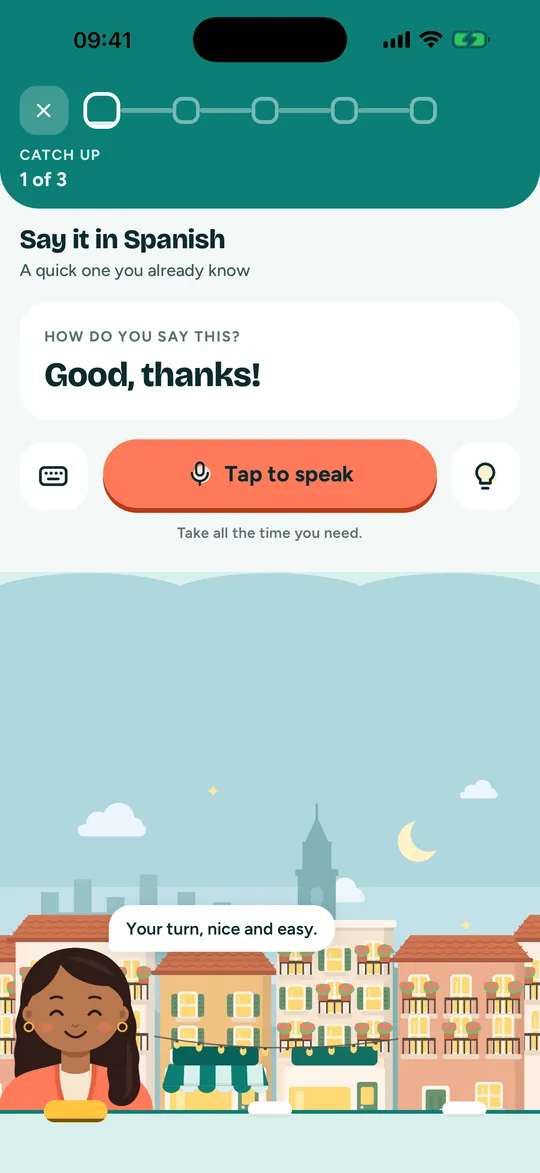
A speaking step in LingoBestie: you answer your bestie aloud in a short roleplay.
How we compared the tools
We judged each tool on six questions:
- Do you speak aloud in the first session, or only tap?
- Does it teach hiragana and katakana, and keep you reading them afterwards?
- How does it handle kanji: a few characters in context, or a full system?
- Does it explain politeness levels with spoken examples, not only a chart?
- Does it prepare you for the JLPT in the official sections?
- What does it cost, from the vendor's own page, and when did we check?
We used what each vendor's page or store listing states. Prices move, so every price in this article carries a "checked October 2026" note and a link. Where an official page does not list a price, we say so and link to the page.
The four skills of Japanese, and the tool that suits each
| Skill | What it demands | What works best | Where LingoBestie fits |
|---|---|---|---|
| Speaking | Producing sentences in real time, in the right politeness level | Daily voice practice with correction | Chat, voice call and video call with a bestie who stays in your level; roleplays |
| Listening | Catching words at natural speed, including the particles that are said quickly | Lots of short, clean audio, then real speech | Every lesson has a listening step; N5 to N2 listening practice by section |
| Reading | Hiragana, katakana, then kanji in context | Short texts with instant lookup | Reading pages with tappable words you can save; kanji introduced in small groups |
| Kanji volume | Several hundred characters, each with readings | Spaced repetition | Kanji in context in the course, and a kanji tool as an optional power up for reading even faster |
Treating Japanese as one skill is the common trap. Learners who only use flashcards can read 300 kanji and still freeze when a waiter says 「ご注文はお決まりですか」. Learners who only chat can order dinner and still cannot read the menu. LingoBestie puts the centre of gravity on speaking and listening, where most of the fading happens, and lets the reading and kanji tools you pick plug in around it.
For the general principles behind that, see how to practice speaking a new language.
Month 1: hiragana, and how to speak from day one
Most guides tell you to finish a kana chart before you say anything. That wastes the first two weeks in silence. A better order is to learn the sound system and a handful of sentences together, and let the writing follow.
Here is what a real first week looks like in the LingoBestie Japanese course. Unit 1 is はじめまして. By your fifth fifteen minute session you can greet, say your name, answer when someone introduces themselves, say おはようございます and ありがとうございます, and ask for a repeat with もういちどおねがいします. In the same five sessions you meet five hiragana rows, あいうえお through なにぬねの, always beside words you just said aloud. The writing is no longer an abstract shape: it is the sound you used a minute ago.
Hiragana comes in rows, then the voiced marks (がぎぐげご and so on), the small ゃゅょ and the small っ. All of it sits inside step 0, which is units 1 to 4 and the first 20 sessions of the course. Units 5 and 6 add your first words about time and about yourself. Katakana starts in step 1, session 31, with アイウエオ, and builds the same way, including the extended sounds such as ァィゥェォ that you need for foreign words (ティ, ファ).
A month 1 week plan
| Week | Daily lesson (15 minutes) | Kana focus | Speaking |
|---|---|---|---|
| 1 | Unit 1: greetings, names, repair phrases | あ行 to な行 | Say each new line aloud twice. Introduce yourself to Kiko in a chat |
| 2 | Unit 2 | は行 to ら行, を, ん | A short call: name, thanks, "I do not understand" |
| 3 | Unit 3: numbers and prices (数字と値段) | Voiced marks (が, ざ, だ, ば) | Ask a price in a shop roleplay |
| 4 | Unit 4: ください、おねがいします | ぱ行, small っ, small ゃゅょ | Order a drink in a roleplay, then tell your bestie one thing about your week |
Units 5 and 6 follow in month 2 and bring your first words about time and about yourself, with the kanji 日 and 人. The numbers 一 to 十 arrive earlier, in unit 3.
Two habits make this month work. First, type in kana and skip romaji after day three; romaji quietly teaches you English vowels. Second, record yourself saying the lines once a week and listen back. For a method you can follow alone, the speaking practice guide has a ten minute drill. A few minutes of quick kana recall in the first fortnight with any flashcard app speeds things up, though the course repeats kana through reading and listening already. For the longer view of how many hours a language takes, see how long does it take to learn a language.
The tools compared
Prices are what the vendor or the store listing showed in October 2026, with the source number after each. Where the official page lists no price, the cell says so.
| Tool | What it does best | Price as listed (checked October 2026) | Notes |
|---|---|---|---|
| LingoBestie | Speaking and listening in a full course, plus JLPT N5 to N2 practice | Plus $14.99 a month, or $79.99 a year ($6.67 a month), US storefront [13]. 7 day free trial on the yearly plan | iOS first. Lessons explained in English, Spanish, French, German or Korean |
| WaniKani | Kanji and vocabulary through mnemonics and spaced repetition | $9 a month, $89 a year, $299 lifetime [4] | Kanji and vocabulary |
| Bunpro | Grammar drills and example sentences | $5 a month, $150 lifetime, 30 day Premium trial [5]. Yearly price: see the pricing page | 900 plus grammar items |
| Anki | Any deck you can build or download | Desktop and AnkiDroid free; AnkiMobile on iPhone $24.99 [10] | A tool, not a course. You supply the content |
| renshuu | Free all round study tool: dictionaries, SRS, textbook packs, games | "Start learning for free"; the home page lists no paid tier or price [9] | Web, iOS and Android |
| LingoDeer | Grammar led courses with native speaker audio | The official site lists no regular price; see the site or the App Store [7] | 20 languages, Japanese included |
| Duolingo | A free daily habit | Free with an optional Super subscription; see the App Store listing [8] | Japanese is one of 40 plus languages |
| Noun Town | Speaking vocabulary in a game world | One time purchase on Steam, listed at 19,50 € in the EU store; no subscription [6] | Nouns and basic phrases; kanji not taught as a subject |
| Pimsleur | Spoken Japanese through audio lessons | The course page lists no price; see the page [12] | Spoken Japanese, audio first; the course page does not mention reading |
| Busuu | Structured lessons across 14 languages, Japanese among them | Free to download with ads; a subscription unlocks all features [14] | Prices vary by plan, see the listing |
| HelloTalk | Chatting with native speakers | Free to practise [15] | Text, voice and video with real partners |
A short read on each:
WaniKani is the best-known kanji system. It teaches characters in a fixed order with radicals and mnemonics and reviews them on a schedule. It is the tool we suggest next to LingoBestie: LingoBestie shows you each character in a living sentence, WaniKani makes the shapes automatic.
Bunpro shines when grammar is your priority and you are heading for the upper JLPT levels. Its strength is the volume of example sentences.
Anki is the flexible choice, and the one many serious learners use for mining their own sentences. It is a blank canvas, which suits people who already know what they want to review.
renshuu is a very generous free tool: dictionaries, spaced repetition, textbook packs such as Genki and Tobira, and games [9]. If budget is the main constraint, it earns a place in your stack.
LingoDeer builds its courses around grammar, with explanations and lessons voiced by native speakers from the start [7]. A solid structured course.
Duolingo is excellent at getting you to open the app every day. For a closer look, see Duolingo vs LingoBestie. For Japanese, pair the habit with speaking practice that responds to what you say.
Noun Town is a fun way to hang words on objects and say them aloud.
Pimsleur is built for the ear: audio first lessons in spoken Japanese you can do hands free [12].
Busuu is a mainstream course app with Japanese among its languages [14].
HelloTalk adds the human side: a language exchange where you chat by text, voice or video with native speakers [15]. It pairs well with a daily course, because LingoBestie gives you the sentences to bring into those chats.
One dictionary worth installing: a good lookup app saves hours. imiwa? is an offline dictionary for iPhone and iPad with kanji tools, a grammar guide and flashcards [16]. Takoboto is a Japanese and English dictionary with example sentences and kanji information, in a browser and as an app [17].
Who should pick which
- You have 15 minutes a day and want to talk: LingoBestie. Add a kanji tool in week 3 or 4.
- You already read kana and want kanji fast: WaniKani or Anki, with LingoBestie for the speaking.
- You are preparing for the JLPT: LingoBestie's N5 to N2 practice, Bunpro for extra grammar volume.
- Your budget is zero this month: renshuu, Anki and Duolingo's free tier, plus the 7 day LingoBestie trial to test speaking.
- You like audio on the commute: Pimsleur next to a daily LingoBestie session.
- You want a human partner: HelloTalk, after your first two weeks of lessons so you have sentences to use.
Is it worth paying?
You can start Japanese for free: renshuu and Anki cost nothing to begin, Duolingo has a free tier, HelloTalk is free to practise, and Bunpro gives a 30 day Premium trial [5]. What free tools rarely give you is a conversation partner who answers in your level, remembers you and moves you forward each day. LingoBestie Plus covers every lesson, every bestie, voice and video calls and the JLPT practice for $79.99 a year, about $6.67 a month, and you can try the yearly plan for 7 days free with no payment today. If you want a tutor-priced comparison, see AI tutor vs human tutor.
Where LingoBestie wins
The thing a single purpose tool cannot do is put the whole path into one conversation, so you do not stop learning to go and practise. Concretely:
- Speaking at the centre. Every lesson has five short steps: look back, listen, warm up, play it out in a roleplay, wrap up. The roleplay is where you say full sentences, not pick from a list. From a roleplay you can move to a chat, a voice call or a video call, and calls come with a summary.
- A friend who remembers you. Tell Kiko about a job interview and she asks how it went the day after. You can see what she remembers, change it, or take any memory out.
- Reading you can lean on. Reading pages let you tap any word for its meaning and save it to your Words for review.
- One path from nothing to B1. About 460 sessions, Pre A1 to B1, so you never have to decide what comes next.
- JLPT inside the same app. 395 practice tasks across N5 to N2 in the official sections, with mocks.
- Your own language. Explanations come in English, Spanish, French, German or Korean, and the app interface comes in 15 languages.
- A 7 day free trial on the yearly plan, with no payment today.
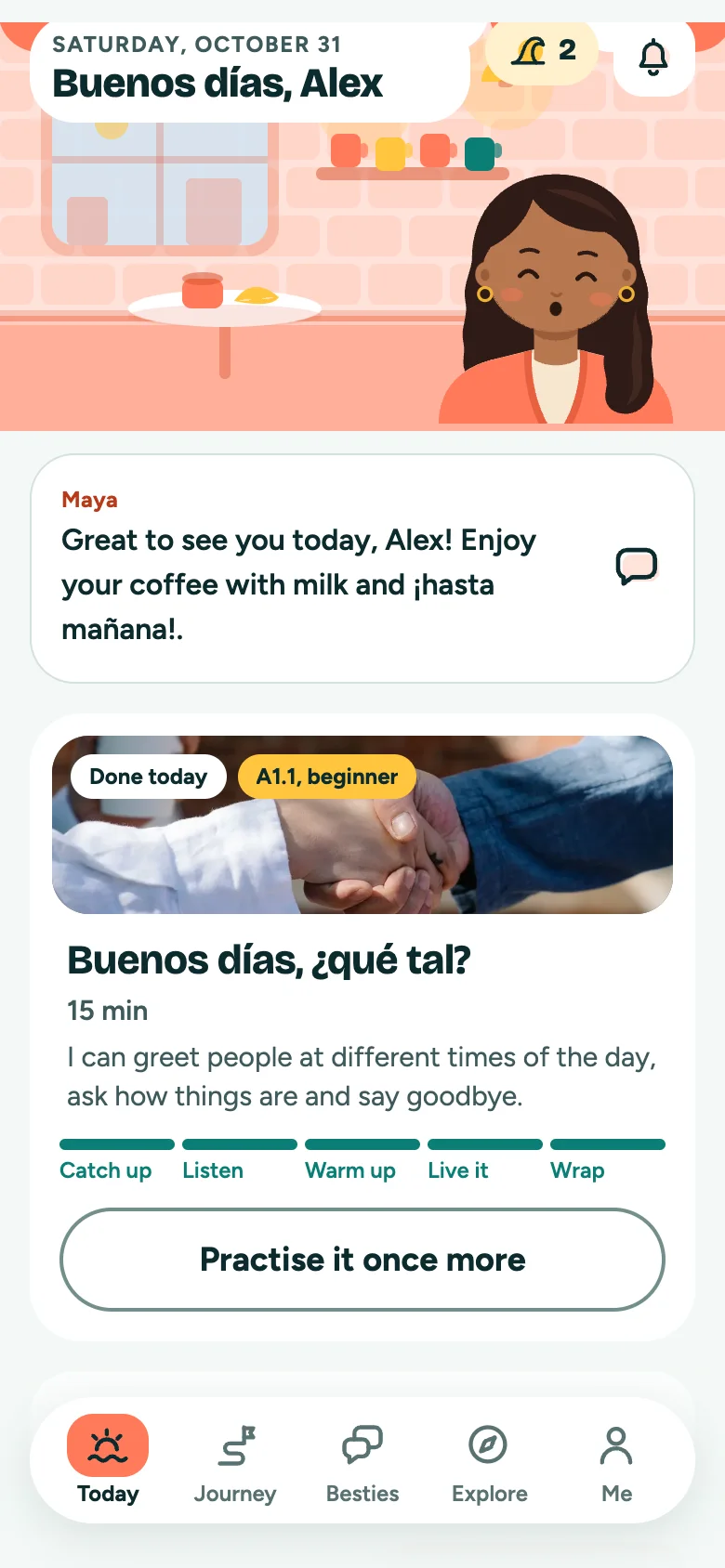
The Today screen: your session, your streak and your bestie in one place.
Politeness levels, with real conversations
Japanese has more than one way to say the same sentence, and the choice tells the listener how you see them. A beginner needs three layers.
| Layer | Name | Where you hear it | Verb example (to eat) |
|---|---|---|---|
| Casual | 普通形 (plain form) | Friends, family, close colleagues | 食べる, 食べない, 食べた |
| Polite | です・ます形 | Strangers, shops, work, teachers | 食べます, 食べません, 食べました |
| Honorific | 敬語 (keigo) | Customer service, formal work, announcements | 召し上がる (honorific), いただきます (humble) |
You do not need to produce keigo in your first year, but you will hear it, so recognise it. Your active target is polite speech first, and casual speech second.
The same sentences, two registers
| Meaning | Casual | Polite |
|---|---|---|
| What are you eating today? | 今日、何食べる? | 今日は何を食べますか。 |
| I want ramen. | ラーメン食べたい。 | ラーメンが食べたいです。 |
| I do not understand. | わかんない。 | わかりません。 |
| Thank you. | ありがとう。 | ありがとうございます。 |
| I saw a film yesterday. | 昨日、映画見たよ。 | 昨日、映画を見ました。 |
| I will not go. | 行かない。 | 行きません。 |
| Yes, that is fine. | うん、いいよ。 | はい、いいですよ。 |
The casual forms drop the particles を and は. That is natural in speech and a sign of closeness, not carelessness. In writing, and in polite speech, you keep them.
Conversation 1: ordering in a cafe (polite)
| Speaker | Line | Meaning |
|---|---|---|
| 店員 | いらっしゃいませ。ご注文は? | Welcome. What would you like? |
| あなた | アイスコーヒーをひとつ、おねがいします。 | One iced coffee, please. |
| 店員 | サイズはどうしますか。 | Which size? |
| あなた | Mサイズで、おねがいします。 | Medium, please. |
| 店員 | 店内でお召し上がりですか。 | Eating in? |
| あなた | はい、ここで飲みます。 | Yes, I will drink it here. |
The staff member uses keigo (お召し上がり). You do not copy it. You answer in clean polite speech, and that is exactly right.
Conversation 2: weekend talk with a friend (casual)
| Speaker | Line | Meaning |
|---|---|---|
| キコ | 週末、何したの? | What did you do at the weekend? |
| あなた | 友だちと映画見たよ。 | I saw a film with friends. |
| キコ | へえ、どんなやつ? | Oh, what kind? |
| あなた | アニメ。すごくおもしろかった! | Anime. It was so good! |
| キコ | いいなあ。今度、私も行きたい! | Nice. Next time I want to go too! |
The course gives this switch a whole unit, 友だちと、ふつうに話す, inside step 3, so you learn casual forms once polite ones feel secure. Starting casual with a stranger sounds rude; starting polite with a friend only sounds stiff.
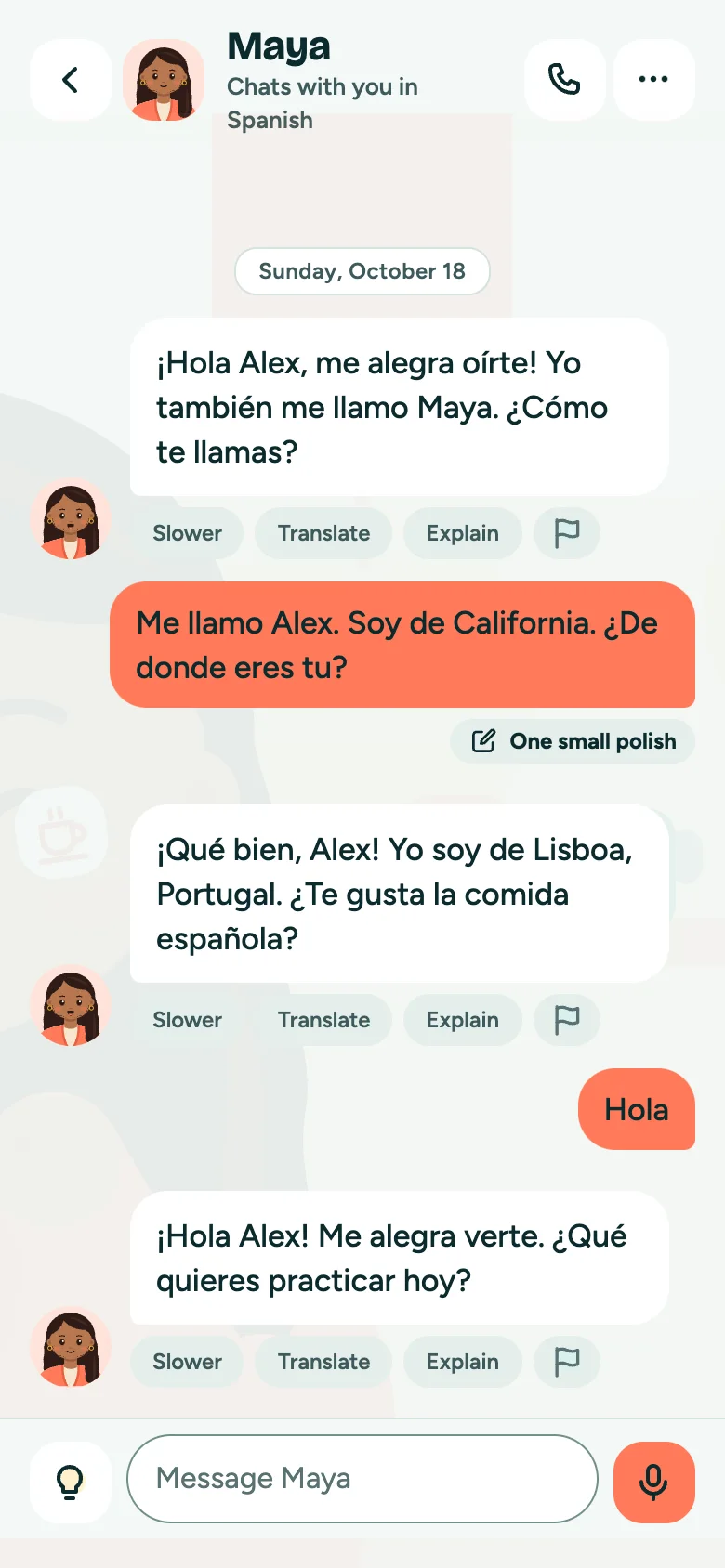
A chat with a bestie, where you can answer in Japanese at your own pace.
A rule of thumb that works in practice: use です・ます until the other person drops it, then follow gently. When unsure, polite is always safe.
Pitch accent in ten minutes
Japanese has a pitch accent: each word has a melody of high and low syllables, and the melody can separate words that look alike in kana. The classic trio is はし.
| Word | Meaning | Pitch on は・し・が (Tokyo standard) |
|---|---|---|
| 箸 | chopsticks | high, low, low |
| 橋 | bridge | low, high, low |
| 端 | edge | low, high, high |
Add a particle and the difference shows. 橋が drops after し, while 端が stays high through が. Three habits make pitch easy to pick up. Listen to the whole sentence before you copy it. Repeat each line aloud twice, matching the melody and not only the sounds. Record yourself and compare. Standard Japanese in lessons gives you one clear model to copy, and the Kansai accent, like Kiko's chat voice, has different patterns, which is a bonus to notice, not a problem. You do not need to master pitch before you speak: learn it the way Japanese children do, by listening a lot.
Japanese for travel, anime and work
Your reason shapes your first 100 sessions. For travel, the early units (greetings, asking where things are, numbers and prices, ordering) give you the phrases at stations, shops and restaurants within weeks. For anime and games, learn the plain form early; unit 6 of step 3 teaches the casual register, and recognising 〜ている, 〜たい and 〜ない makes dialogue click. For work, stay with polite speech and the step 4 units on official procedures and the workplace. Whatever the reason, the daily five-step lesson is the same, so you can switch focus without switching apps.
JLPT N5 to N2: what each level means and how LingoBestie prepares you
The JLPT (Japanese-Language Proficiency Test) has five levels, N5 to N1, and N5 is the easiest. The official descriptions are short and useful [1]:
| Level | Official summary | In plain words |
|---|---|---|
| N5 | Understand some basic Japanese | Read hiragana, katakana and basic kanji; follow short, slow everyday exchanges |
| N4 | Understand basic Japanese | Read familiar daily topics; follow slow daily conversation |
| N3 | Understand Japanese used in everyday situations to a certain degree | Follow near natural speed conversation; read everyday content and headlines |
| N2 | The ability to understand Japanese used in everyday situations, and in a variety of circumstances to a certain degree | Read articles and commentaries; follow news and conversation at near natural speed |
| N1 | Understand Japanese in a variety of circumstances | Abstract and complex texts; lectures at natural speed |
The CEFR mapping that circulates online (N5 about A1, N4 about A2 and so on) is not official, so treat it as a rough guide.
What the exam looks like
The official structure [2][3]:
| Level | Test sections (minutes) | Total minutes | Pass mark (of 180) | Sectional minimum |
|---|---|---|---|---|
| N5 | Vocabulary 20, Grammar and Reading 40, Listening 30 | 90 | 80 | 38 of 120 on Language Knowledge and Reading, 19 of 60 on Listening |
| N4 | Vocabulary 25, Grammar and Reading 55, Listening 35 | 115 | 90 | 38 of 120 on Language Knowledge and Reading, 19 of 60 on Listening |
| N3 | Vocabulary 30, Grammar and Reading 70, Listening 40 | 140 | 95 | 19 of 60 in each of Language Knowledge, Reading and Listening |
| N2 | Language Knowledge (Vocabulary and Grammar) and Reading 105 as one block, Listening 50 | 155 | 90 | 19 of 60 in each of Language Knowledge, Reading and Listening |
| N1 | Language Knowledge (Vocabulary and Grammar) and Reading 110 as one block, Listening 55 | 165 | 100 | 19 of 60 in each of Language Knowledge, Reading and Listening |
- Total test time (minutes)
| Total test time (minutes) | |
|---|---|
| N5 | 90.0 |
| N4 | 115.0 |
| N3 | 140.0 |
| N2 | 155.0 |
| N1 | 165.0 |
Two details that surprise people. First, you must meet both the total pass mark and every sectional minimum, so a strong reading score cannot rescue a weak listening score. Second, scores are scaled, not raw counts, so "I got 70 percent right" does not translate directly to a pass or a fail.
Official format practice in LingoBestie
LingoBestie has JLPT N5 to N2 practice in the official sections, 395 tasks in total, with mocks and practice by section: vocabulary, grammar, reading and listening.
| Level | Mock tasks | Vocabulary | Grammar | Reading | Listening | Total |
|---|---|---|---|---|---|---|
| N5 | 14 | 20 | 15 | 15 | 20 | 84 |
| N4 | 16 | 25 | 15 | 15 | 20 | 91 |
| N3 | 19 | 25 | 15 | 20 | 25 | 104 |
| N2 | 21 | 30 | 15 | 25 | 25 | 116 |
Practising by section finds your weak spot fast. If listening trails, you do the listening tasks (20 at N5 and N4, 25 at N3 and N2) and nothing else for a week. Results show the share you answered correctly in each section, so you see exactly which section to practise next. Use a recent official sample paper from the JLPT site close to the exam date to rehearse the real timing.
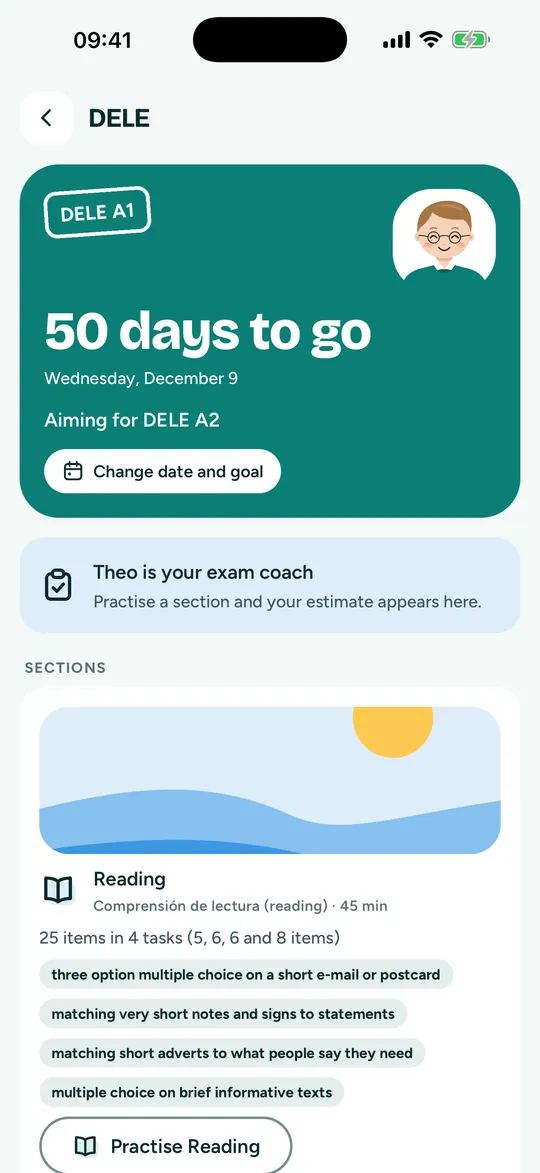
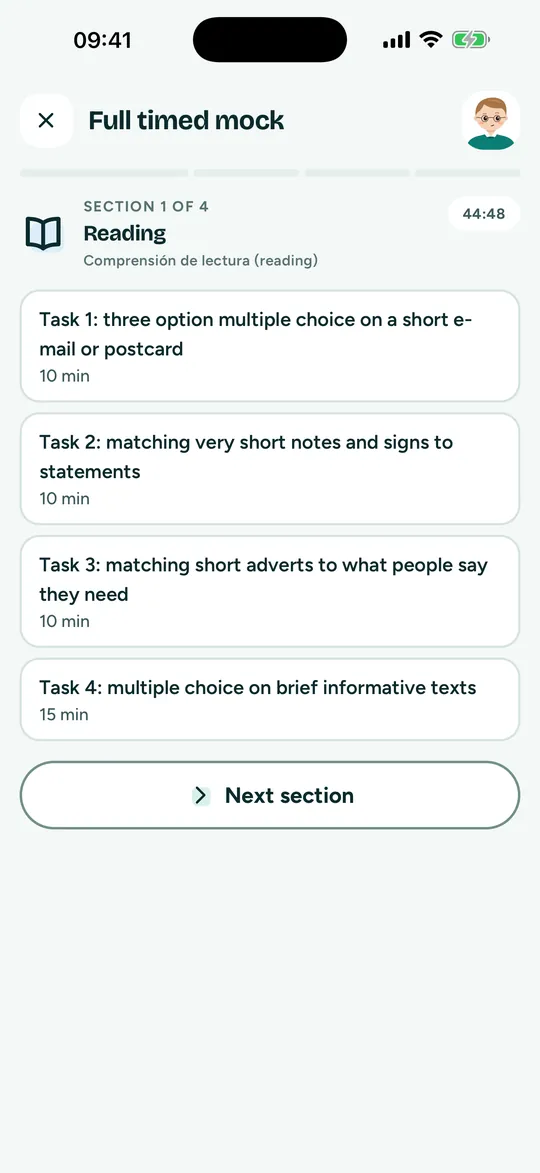
Exam practice by section, and a full mock with a timer.
A 6 month roadmap to N5 and a 12 month roadmap to N4
The JLPT does not publish study hours per level, and people differ a lot, so these are planning models built on a steady four and a half to seven hours a week. With more time, you go faster.
The course itself gives the real shape of the journey. Sessions per step are 30, 30, 35, 95, 95, 90 and 85. At five sessions a week, that is about 6, 6, 7, 19, 19, 18 and 17 weeks.
- Sessions in the step
| Sessions in the step | |
|---|---|
| Step 0 | 30.0 |
| Step 1 | 30.0 |
| Step 2 | 35.0 |
| Step 3 | 95.0 |
| Step 4 | 95.0 |
| Step 5 | 90.0 |
| Step 6 | 85.0 |
| Phase | When | Goal | Weekly rhythm |
|---|---|---|---|
| Kana | Month 1 | All of hiragana; first spoken sentences | 5 lessons a week, 2 short chats, 5 minutes of kana recall |
| N5 base | Months 2 to 6 | Finish steps 0 to 2 (95 sessions); about 100 kanji from the tool; katakana from session 31; sit an N5 mock | 5 lessons, 2 calls, kanji tool every day, one exam section a week from month 4 |
| N5 test | End of month 6 | Full N5 mock under timed conditions | One mock, then fix the weakest section |
| N4 conversation | Months 7 to 12 | Work through step 3 (95 sessions, about 19 weeks), speak politely and plainly, practise the N4 sections, sit a full N4 mock | 5 lessons, 3 calls, kanji tool every day, 2 exam sessions a week |
If an N5 pass is your goal, month 6 is a realistic target for someone studying about five hours a week. For N4, a year is a sensible plan. A missed week is not a failure: LingoBestie's two rest days a week keep your streak safe, so you can come back without guilt. For a practice-focused study sequence, see our JLPT N5 and N4 study guide.
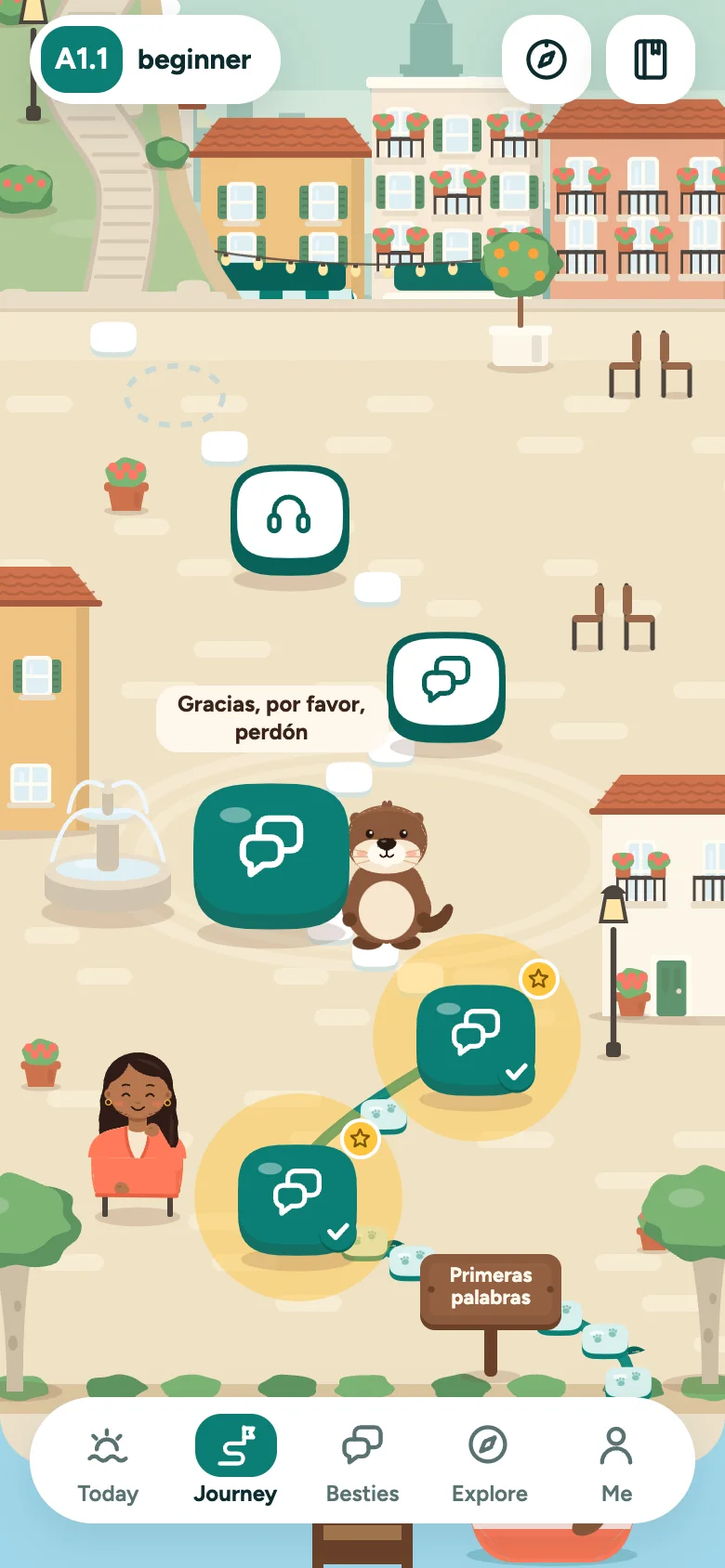
The Journey map: seven steps from Pre A1 to B1.
LingoBestie Japanese in detail
The Japanese course is built from seven steps, step 0 to step 6, which carry you from Pre A1 to B1: 460 sessions of about fifteen minutes each.
| Step | Sessions | What you can do at the end |
|---|---|---|
| 0 | 30 | Greet, introduce yourself, count and ask prices, order with ください, say the time; read all of hiragana and 13 first kanji (一 to 十, 円, 日, 人) |
| 1 | 30 | Katakana, family and everyday kanji (友父母子, 国, 毎食飲, 週見, 駅, 月火水木金土), simple everyday exchanges |
| 2 | 35 | Say what you like and want, ask permission, describe and buy things, talk about your day and your health, ask for help with words, and chat with friends |
| 3 | 95 | Ask what someone is doing, say what you can do and have done, give opinions, make plans, order in a restaurant, give directions, and speak plainly with friends |
| 4 | 95 | Manage official procedures, the doctor and the pharmacy, time off work and workplace rules |
| 5 | 90 | Hold longer conversations on work, home and daily life |
| 6 | 85 | Reach B1 and handle situations you could not predict |
The descriptions for steps 0 to 4 come from the unit titles in the course syllabus. Steps 5 and 6 widen the same life situations into longer, less predictable conversations.
Kiko, your Japanese bestie
Kiko Morita is 24 and lives above a record shop in Amerikamura, Osaka. She was born above her grandmother's takoyaki stand in Shinsekai, spent age seven to seventeen in Melbourne, and now writes film subtitles and hosts a weekend radio show, so her job is listening to how real people speak.
In lessons she speaks standard Japanese. Her Osaka warmth comes out in chat and calls, and when something like ほんま? slips out she tells you which line is standard Japanese. If you are nervous she turns the first line into a duet: "I'll say half, you say half. Deal?" She is an AI friend, and she says so when you ask.
You can meet the other besties and switch at any time. Kiko suits you if you like speed, slang and humour; for a calmer pace, Nori helps you pick another bestie in a minute.
Adding kanji: how to pair a kanji tool with daily lessons
LingoBestie introduces kanji in small groups beside the lessons they belong to: the numbers 一二三四五 and 六七八九十 in step 0 next to the vocabulary that uses them, 日 and 人 in units 5 and 6, then 友, 国, 駅 and 電車 as you meet those words. Meeting characters inside sentences is what makes them stick. A kanji tool then adds volume: it repeats hundreds of characters on a schedule, so the shapes become automatic and your reading gets faster still.
A pairing that works:
- Start the kanji tool in week 3 or 4, once you can read hiragana without thinking. Starting on day one splits your attention.
- Ten minutes a day, no more. Do the reviews first when you are fresh, then the lesson.
- Let the lesson pick the words. When a lesson introduces 駅, look it up in the tool the same day. The same character in three places is what makes it stick.
- Learn readings inside words. Learn 電車 (でんしゃ) as a word, not 電 (デン) and 車 (シャ) as unrelated facts. The lesson gives you the word in a sentence.
- Tap, save, review. When you meet an unknown word on a reading page, tap it, save it to your Words, and let the review bring it back.
WaniKani, Anki and renshuu are all good here. WaniKani gives a fixed order, Anki a blank page, and renshuu a free full system. Pick the one you will open daily.
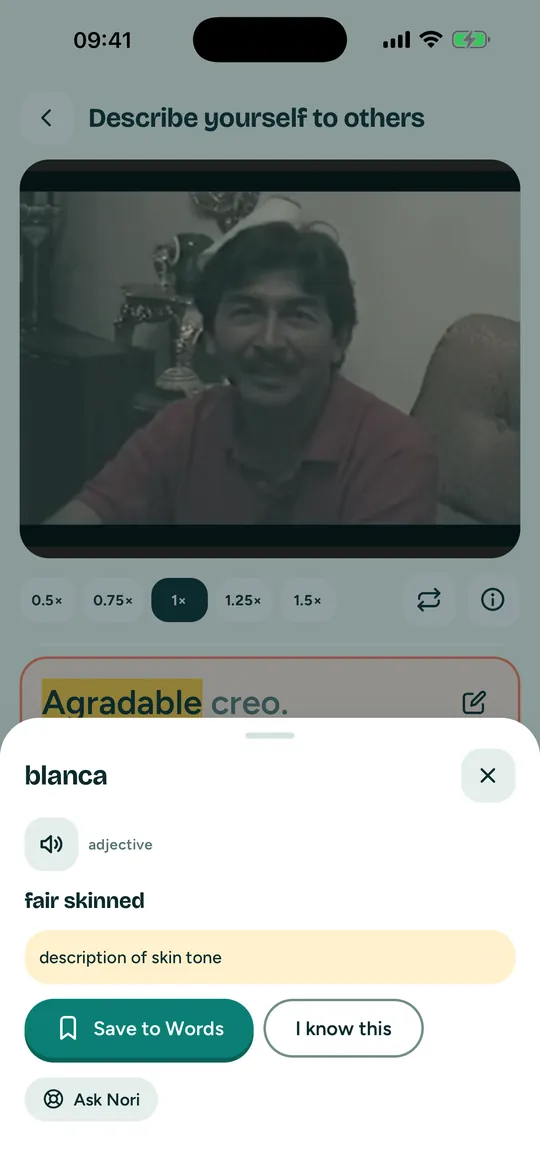
Tap any word on a reading page to see its meaning and save it.
Learning Japanese from Spanish, French, German or Korean
Your language shapes what is hard in Japanese. A good explanation uses what you already know. LingoBestie's lessons are explained in English, Spanish, French, German or Korean, with support content in each language for nearly every session, and the app interface comes in 15 languages.
| You speak | Typical trap | How the lesson frames it |
|---|---|---|
| Spanish | Expecting the verb in the middle: Yo bebo café | Japanese puts the verb last. 私はコーヒーを飲みます is "yo, café, bebo", with は marking the topic and を the thing you drink |
| French | Looking for articles (le, la, un) | There are no articles. コーヒー can be "the coffee" or "a coffee", and context tells you |
| German | Wanting cases for every noun | Particles do the job of cases. を is close to the accusative and に often to the dative |
| Korean | Almost none: the word order is the same | Particles line up: は with 는/은, が with 이/가, を with 을/를, に with 에. Learn the differences, not the basics |
For Korean speakers the grammar is a gift, and the work moves to vocabulary and kanji. If you are going the other way, our guide to the best app to learn Korean covers it. For a wider view across languages, see the best language learning apps.
Frequently asked questions
What is the best app to learn Japanese for beginners?
For a beginner who wants to speak, LingoBestie. It starts with greetings and hiragana in the first sessions, has you say real sentences from day one, and carries you to B1 in about 460 sessions. Add a kanji tool such as WaniKani for ten minutes a day to read even faster.
Can I learn Japanese with one app?
You can learn a great deal in one app. LingoBestie covers speaking, listening, kana, reading in context and JLPT practice, and a kanji tool is an optional extra for volume.
Should I learn hiragana and katakana first?
Yes, within the first weeks, and alongside your first spoken sentences. Both syllabaries are small, and everything else, including the readings printed above kanji, builds on them. Read and write in kana from the start and skip romaji.
How long does it take to reach JLPT N5?
The JLPT does not publish study hours. On a steady five hours a week, six months is a sensible plan, laid out above as a planning model. The US Foreign Service Institute puts Japanese among its hardest categories for English speakers, about 88 weeks or 2,200 class hours to reach professional working proficiency [11], so N5 is a first step on a longer road, and a motivating one.
Is Duolingo enough for Japanese?
Duolingo is a good way to keep a daily habit and meet the script. For speaking with feedback, politeness levels and exam practice, add a speaking led course. The Duolingo vs LingoBestie comparison goes through the differences.
How is the JLPT scored?
Each level is scored out of 180. You need the overall pass mark (80 for N5, 90 for N4, 95 for N3, 90 for N2, 100 for N1) and the minimum in each scoring section [3]. A weak listening score fails you whatever the total.
Do I need to learn kanji from the beginning?
You meet some from the first sessions, a few at a time, which is plenty at first. Start a dedicated tool in week three or four if you want to read faster.
Is there a Japanese app with AI conversation?
Yes. LingoBestie has chat, voice calls and video calls with besties, AI friends who remember what you told them, say plainly that they are AI, and adjust to your level. Kiko is the Japanese bestie. You can talk with her from Pre A1 through B1, in a course explained in English, Spanish, French, German or Korean. For how to judge any AI tutor, see the AI language tutor app guide.
Is Japanese hard for English speakers?
It takes time: the Foreign Service Institute places it in its hardest group for English speakers [11]. The good news is that the sound system is small and regular, there are no articles or gendered nouns, and the pieces arrive in a clear order: sounds and kana first, then polite sentences, then kanji and casual speech. Daily short practice beats occasional long sessions.
Can I learn Japanese for free?
You can begin for free with renshuu, Anki, Duolingo's free tier and HelloTalk. Add a daily speaking course when you want feedback on what you say; LingoBestie offers a 7 day free trial on the yearly plan.
Sources
All facts about other products were taken from their official pages or store listings and checked in October 2026. LingoBestie facts come from the product itself: the app, the Japanese course syllabus, the JLPT practice files and the character bible.
- Japanese-Language Proficiency Test, "Summary of the Linguistic Competence Required for Each Level". https://www.jlpt.jp/e/about/levelsummary.html , checked October 2026.
- JLPT, "Test sections" (section times by level). https://www.jlpt.jp/sp/e/guideline/testsections.html , checked October 2026.
- JLPT, "Results" (scoring sections and passing criteria). https://www.jlpt.jp/e/guideline/results.html , checked October 2026.
- WaniKani, "WaniKani Premium Membership" (monthly, annual and lifetime prices). https://knowledge.wanikani.com/getting-started/account-and-membership/payment-and-billing/wanikani-premium-membership/ , checked October 2026.
- Bunpro, "Pricing" (Premium monthly, Lifetime, 30 day trial, content counts). https://bunpro.jp/pricing , checked October 2026.
- Noun Town, "Learn Japanese on PC with Noun Town" (platforms, no subscription, kana and kanji treatment). https://noun.town/language-learning-game/japanese/ , and the Steam store page https://store.steampowered.com/app/2313720/ (19,50 € in the EU store), checked October 2026.
- LingoDeer, official site (20 languages, grammar led courses, native speaker audio). https://www.lingodeer.com/ , checked October 2026.
- Duolingo on the App Store (learning 40 plus languages, Super subscription). https://apps.apple.com/us/app/duolingo-language-lessons/id570060128 , checked October 2026.
- renshuu (features, platforms, free start). https://www.renshuu.org/ , checked October 2026.
- Anki (desktop free, AnkiDroid free) https://apps.ankiweb.net/ ; AnkiMobile on the App Store ($24.99, US) https://apps.apple.com/us/app/ankimobile-flashcards/id373493387 , checked October 2026.
- US Department of State, Foreign Service Institute, "Foreign Language Training" (language difficulty categories; Category IV about 88 weeks or 2,200 class hours, a professional working proficiency target). https://www.state.gov/foreign-language-training , checked October 2026 via an archived copy: https://webarchive.library.unt.edu/web/20210105072258/https://www.state.gov/foreign-language-training
- Pimsleur, Japanese course page (audio first spoken Japanese; no price on the page). https://www.pimsleur.com/learn-japanese , checked October 2026.
- LingoBestie Plus in the app and App Store plans: $14.99 monthly and $79.99 yearly in the US storefront, with a 7 day free trial on the yearly plan. The App Store shows your local price. Checked October 2026.
- Busuu on the App Store (Japanese among 14 languages, free to download, subscription for all features). https://apps.apple.com/us/app/busuu-language-learning/id379968583 , checked October 2026.
- HelloTalk (language exchange, free to practise, text, voice and video). https://www.hellotalk.com/ , checked October 2026.
- imiwa? (offline Japanese dictionary for iPhone and iPad). https://www.imiwaapp.com/ , checked October 2026.
- Takoboto (Japanese and English dictionary). https://takoboto.jp/ , checked October 2026.
Images: Kiko is a LingoBestie original; the kana row order and pitch accent graphics are original. App screens are captured from the live app at build time.