
On this page
By the LingoBestie editorial team. Last checked 31 October 2026. German examples follow the German syllabus of our own course.
The short answer. LingoBestie is the best app to learn German if you want to speak from the first minute: 450 guided sessions from Pre A1 to B1, with a bestie who remembers you in chat, voice and video calls. Preply is best for a human teacher, Duolingo for a free daily habit, and Nicos Weg for free video.
Best for, at a glance
| If you want | Pick | Why |
|---|---|---|
| Speaking from day one | LingoBestie | You say German aloud in the first session, then keep going by chat and call |
| A human teacher | Preply | Independent tutors, trial lesson |
| A free daily habit | Duolingo | Every course is free to start |
| A classic structured course | Babbel | Beginners up to upper intermediate, free trial lesson |
| Free video at A1 to B1 pace | Nicos Weg (DW) | Free, made by Deutsche Welle |
| Reading and listening | LingQ | Your own texts, tap to save words |
Start your 7 day free trial on iOS (the yearly plan includes the 7 days; iOS comes first).
How the apps compare for German
How we scored
We scored the apps readers ask about most on five things that decide whether German sticks. The weights reflect the hurdles later on this page.
| Criterion | Weight | What we looked for |
|---|---|---|
| Speaking from day one | 25 | You produce German aloud in session one and it keeps going at B1 |
| Grammar made visible | 25 | Gender, cases and verb position taught by pattern, then used in your own speech |
| Path to B1 | 20 | A published level framework, a lesson count, a clear next step |
| Memory and personalisation | 15 | The app remembers who you are and what you said |
| Explanations in your language | 15 | Grammar explained in the language you think in |
Evidence. We make LingoBestie. The scores are editorial opinion from the LingoBestie editorial team, set on 31 October 2026 from the features each official page and store listing documents; we did not hands-on test the competitors. Our hub scoring of 12 apps across all languages uses general weights, so Babbel is 58.4 there and 66.5 here: this page weights visible grammar and L1 explanations higher because German needs them.
| App | Speaking (25) | Grammar visible (25) | Path to B1 (20) | Memory (15) | Own language (15) | Total /100 |
|---|---|---|---|---|---|---|
| LingoBestie | 9 | 8 | 8 | 9 | 9 | 85.5 |
| Preply | 9 | 7 | 5 | 6 | 6 | 68.0 |
| Babbel | 5 | 8 | 8 | 4 | 8 | 66.5 |
| Busuu | 5 | 6 | 8 | 5 | 6 | 60.0 |
| Praktika | 8 | 5 | 4 | 7 | 5 | 58.5 |
| LingQ | 3 | 5 | 7 | 5 | 5 | 49.0 |
| Duolingo | 4 | 5 | 5 | 4 | 6 | 47.5 |
Basis in one line each. Preply: live conversation with a tutor, but the path depends on the tutor. Babbel: published levels and explained grammar, little speaking depth. Busuu: A1 to B2 course with speaker feedback, AI Conversations on Premium Plus. Praktika: AI voice tutors, no published level map. LingQ: reading and listening first, speaking last. Duolingo: short exercises and a free habit, no published level map we could cite. Pimsleur and Nicos Weg are listed below but not scored, because one is audio only and the other is a free video course.
Price, free tier and levels
Prices change by country and promotion. Check the store before you subscribe.
| App | Free to start | Paid price reported (October 2026) | Levels |
|---|---|---|---|
| LingoBestie | 7 day trial on the yearly plan | $14.99 a month or $79.99 a year ($6.67 a month); Family up to six | Pre A1 to B1 |
| Duolingo | Every course is free | Super reported around $84 a year in the US | Not published on the listing |
| Preply | Trial lesson (25 or 50 minutes) | Sampled 50 minute lessons from €20 to €40 | Set by your tutor |
| Babbel | Free trial lesson | Reported about $8.95 a month on 12 months, $17.95 monthly | Beginners to upper intermediate |
| Busuu | Free sign-up | Premium and Premium Plus, see the plans page | A1 to B2 |
| Praktika | Free download | About $8 a month on the homepage | Not published |
| LingQ | Free to start | Premium reported $14.99 a month or $119.99 a year | Self-paced |
| Pimsleur | Free lesson | About $20 a month reported | Five levels reported |
| Nicos Weg | Free | Free | A1 to B1 |
What each one is best at
1. LingoBestie: best for learning German by speaking it. 450 guided sessions across Pre A1 (30), A1 (70), A2 (185) and B1 (165), each made of five beats of about 15 minutes: catch up, listen, warm up, live it in a roleplay, wrap up. Lessons are explained in any of six languages. Chat, voice and video calls come on top, along with Watch, Listen and Read for real German. Plus is $14.99 a month or $79.99 a year, and the yearly plan starts with 7 days free. Details in the course section.
2. Duolingo: best for a free daily habit. Duolingo's App Store listing says every course is free and offers a 14 day trial of Super. It is a good way to build a streak. If you want to speak aloud and have the cases explained, pair it with something conversational. Our Duolingo vs LingoBestie comparison goes through it feature by feature. Source: Duolingo on the App Store, checked October 2026.
3. Preply: best for a human teacher. A marketplace of independent tutors with a 25 or 50 minute trial lesson and a money back guarantee after the first lesson. A tutor can read your face and adapt. The trade-off is cost per hour, and the path to B1 depends on the tutor. Read AI tutor vs human tutor to decide how to split your time. Source: preply.com/en/online/german-tutors, checked October 2026 (over 3,000 tutors listed; figures move daily).
4. Babbel: best for a classic, polished course. Its German page describes courses from absolute beginners up to upper intermediate, a free trial lesson and AI conversation practice with speech feedback through Babbel Speak. Source: babbel.com/learn-german, checked October 2026. Price figures come from NerdWallet, checked October 2026.
5. Busuu: best for community feedback. The German course covers A1 to B2 with 420+ lessons, free sign-up and feedback from German speakers. Per Busuu's help page, Premium Plus adds AI Conversations, pronunciation feedback and exclusive courses on top of Premium. Sources: busuu.com German course and Busuu Premium plans, checked October 2026.
6. Praktika: best for casual AI chat. AI tutor app with named tutors and adjustable correction, listed at about $8 a month on its homepage. German is among the languages on its App Store listing. Sources: praktika.ai and Praktika on the App Store, checked October 2026.
7. LingQ: best for readers and listeners. Input first: German audio with transcripts, a reader that marks known words, spaced repetition and import of your own content. A strong second tool for intermediate learners. Source: lingq.com German page, checked October 2026; prices from LingQ's own blog.
8. Pimsleur: best for audio in the car. Audio lessons you repeat aloud. Reported at about $20 a month with a 7 day trial and five levels of German. Sources: pimsleur.com and Lingoda's 2026 German app roundup, checked October 2026.
The best free options to learn German
The best free app to learn German is a stack: Nicos Weg from Deutsche Welle for video at A1 to B1 pace (made with the Federal Employment Agency, short episodes, summary on lingoclub.com, checked October 2026), Duolingo for a daily habit, and the free start on LingoBestie, Busuu and LingQ. Add one place where you speak aloud and you cover all four skills at no cost.
German is hard in three places
Vocabulary is friendly: the two languages share a Germanic root, so Hand, Winter, Wasser and Buch arrive almost free. The difficulty is that German makes you commit in every sentence to a gender, a case and a verb position, and each of those is a production problem. You can recognise den Kuchen when you read it. The test is whether den comes out when you are ordering cake.
| Hurdle | The rule in one line | Say it out loud | Beginner trap |
|---|---|---|---|
| Gender | Learn the article with the noun | der Kaffee, die Milch, das Brot | Guessing from English ("a girl must be die", but it is das Mädchen) |
| Accusative | The receiver, and direction | Ich nehme den Kuchen. | Only the masculine changes: der to den |
| Dative | The recipient, position, and after mit, bei, von, zu, nach, aus | Ich helfe dem Nachbarn. | Treating helfen like an English verb |
| Verb second | One thing before the verb | Heute gehe ich ins Büro. | "Heute ich gehe", the English order |
| Verb first | Yes/no questions start with the verb | Kommst du morgen? | Adding a "do" word |
| Verb last | After weil, dass, wenn | ..., weil ich arbeiten muss. | Keeping the verb in the middle |
| Bracket | Two part verbs open and close the sentence | Ich habe gestern Brot gekauft. | Participle straight after the auxiliary |
Cases in plain language
| Case | Masculine | Feminine | Neuter | Plural |
|---|---|---|---|---|
| Nominative | der / ein | die / eine | das / ein | die |
| Accusative | den / einen | die / eine | das / ein | die |
| Dative | dem / einem | der / einer | dem / einem | den + n on the noun |
| Genitive (later) | des / eines + s | der / einer | des / eines + s | der |
Only the masculine moves in the accusative: der to den, ein to einen. After aus, bei, mit, nach, seit, von, zu the noun is dative. The two way prepositions (in, auf, an, unter, über, vor, hinter, neben, zwischen) ask a question: moving to a place (wohin?, accusative) or sitting in it (wo?, dative).
Say each sentence aloud, then change the noun and say it again.
| # | Case | Sentence | Why |
|---|---|---|---|
| 1 | Nominative | Der Bäcker ist freundlich. | Subject |
| 2 | Nominative | Die Wohnung ist hell. | Subject |
| 3 | Nominative | Das Brötchen kostet sechzig Cent. | Subject |
| 4 | Accusative | Ich nehme den Kuchen. | Masculine object: der to den |
| 5 | Accusative | Wir suchen eine Wohnung. | Feminine: no change |
| 6 | Accusative | Hast du mein Handy gesehen? | Neuter: no change |
| 7 | Dative | Ich helfe dem Nachbarn. | helfen takes the dative |
| 8 | Dative | Die Jacke gehört meiner Schwester. | gehören takes the dative |
| 9 | Dative | Ich fahre mit dem Zug. | mit takes the dative |
| 10 | Either | Ich gehe in die Küche. / Ich bin in der Küche. | Movement or position |
| 11 | Both | Ich gebe dem Kunden den Schlüssel. | Recipient dative, thing accusative |
| 12 | Genitive | Das ist das Auto meines Vaters. | In speech: das Auto von meinem Vater |
Word order
The finite verb (V) is the anchor and everything else moves around it.
| Type | Position 1 | V | Middle | End |
|---|---|---|---|---|
| Statement | Ich | gehe | heute | ins Büro |
| Inversion | Heute | gehe | ich | ins Büro |
| Yes/no question | Gehst | du | heute ins Büro? | |
| W question | Wann | gehst | du | ins Büro? |
| Bracket (Perfekt) | Ich | habe | gestern Brot | gekauft |
| Separable verb | Der Zug | fährt | um acht Uhr | ab |
In a clause with weil the finite verb goes last: ..., weil ich heute arbeiten muss. For the middle, the default is time, manner, place: Ich fahre morgen mit dem Zug nach Köln. Spoken German flexes it, but it rarely misleads a beginner. And choose between du and Sie out loud: du with friends and peers, Sie with strangers and officials until they offer du.
LingoBestie German: what is inside
Six steps across the CEFR, 450 sessions in all.
- Guided sessions in the step
| Guided sessions in the step | |
|---|---|
| Step 0 Pre A1 | 30.0 |
| Step 1 A1 | 30.0 |
| Step 2 A1 | 40.0 |
| Step 3 A2 | 100.0 |
| Step 4 A2 | 85.0 |
| Step 5 B1 | 90.0 |
| Step 6 B1 | 75.0 |
Where the hurdles appear. The German syllabus introduces each hurdle as a speaking skill:
| Hurdle | First appears | Lesson in the course |
|---|---|---|
| Verb second | Step 1, unit 1 (session 31) | Ich komme aus ... und wohne in ... |
| Gender with the article | Step 1, unit 2 (session 36) | Was möchten Sie? Ich nehme ... |
| Accusative articles | Step 2, unit 1 (session 61) | Ich suche ... Das hier, bitte |
| Sentence bracket | Step 2, unit 2 (session 67) | Wann fährt der Zug? |
| Perfekt with core verbs | Step 2, unit 6 (session 87) | Gestern habe ich ... gemacht |
| Dative verbs | Step 3, unit 3 | Die Jacke gefällt mir |
| Dative articles and objects | Step 3, unit 3 | Wem gehört die Jacke? |
| Genitive nouns | Step 5, unit 3 | Ein Thema vorstellen |
You meet verb position at the start of A1, long before anyone mentions a case. The accusative arrives when you shop and look for things, where den, einen and keinen actually occur. The dative comes at A2 with gefallen and gehören.
Roleplays that carry the grammar. In every session the fourth beat is a live roleplay with your bestie.
- The bakery. Its own lessons, including Beim Bäcker in Österreich und in der Schweiz and a later one teaching the Austrian Sackerl. Ich hätte gern einen Apfelkuchen und zwei Brötchen is the accusative in one sentence.
- The flat search. In step 4, unit 2 the lessons run: Die Wohnungsanzeige lesen, Bei der Besichtigung, Fragen an die Vermieterin and a listening session, Ein Anruf wegen der Wohnung hören.
- The workplace. Im Team and a meeting you listen to in step 4, Darf ich kurz etwas sagen? in step 5, and Einen Dienst tauschen in step 6.
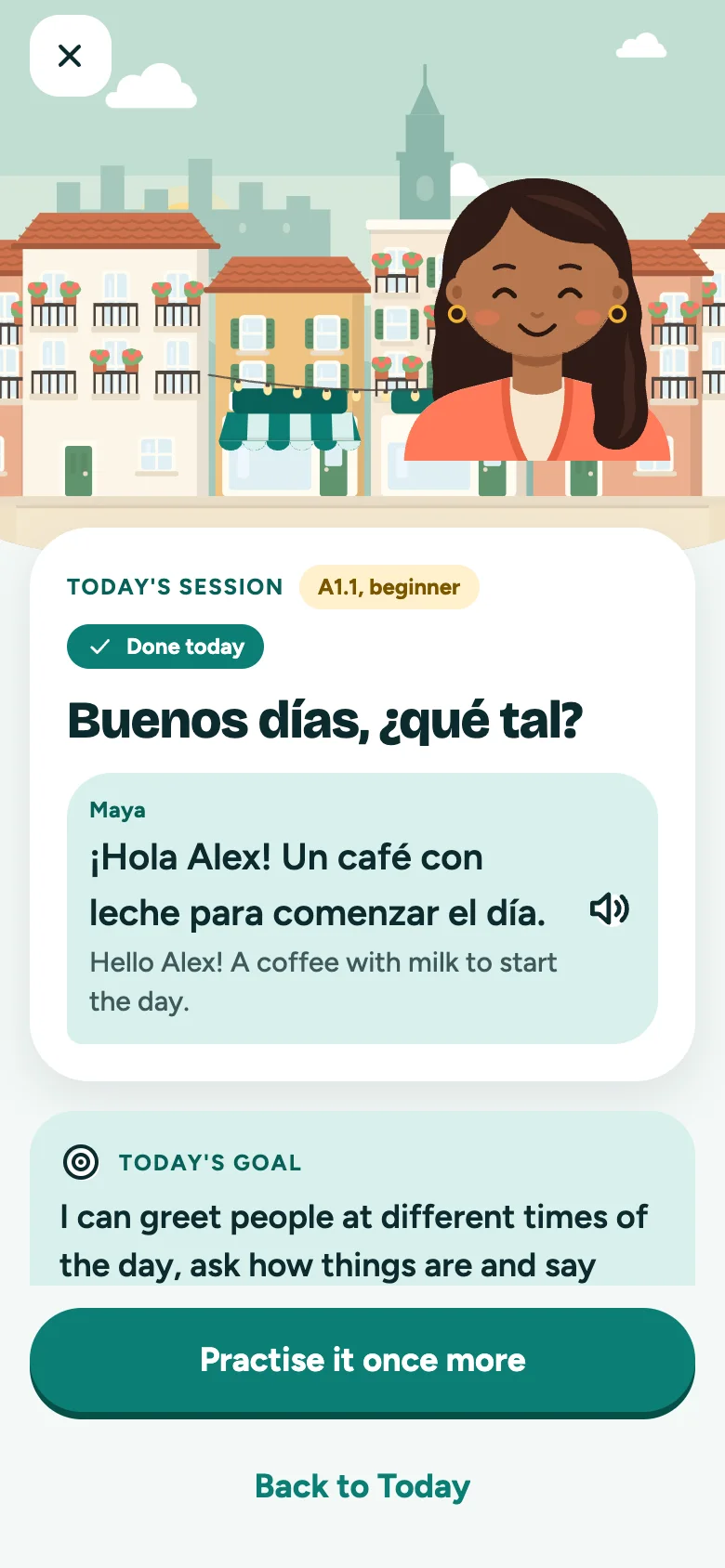
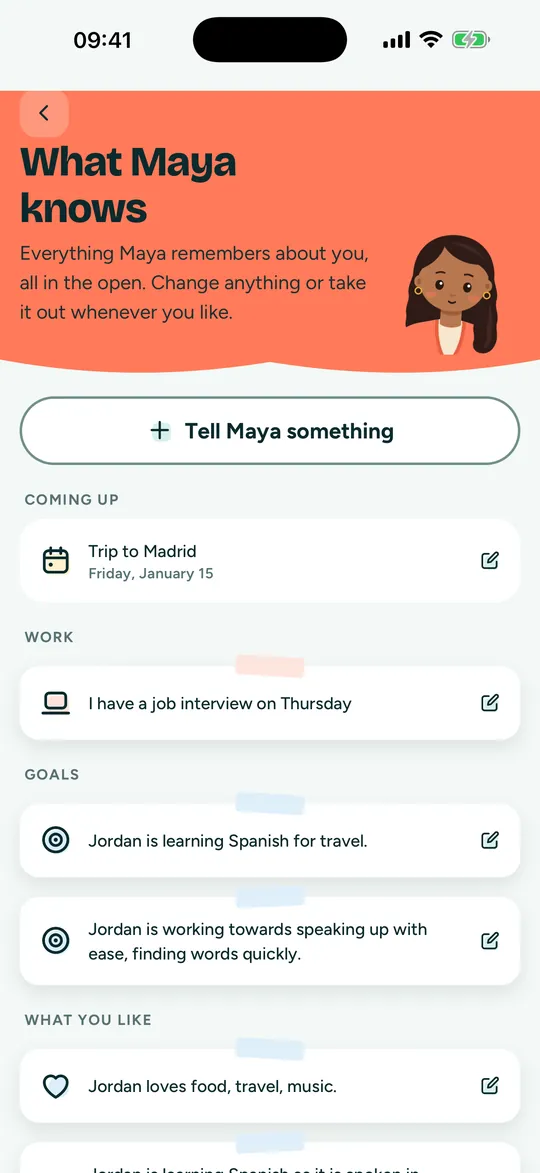
A friend who remembers. The five besties are Nori, Maya, Theo, Kiko and Sam. Theo studied modern languages in Edinburgh with a year in Heidelberg and tutored exams for four years in Berlin, and Maya learned German at a bakery counter in Berlin, so either is a natural companion for German. Your bestie keeps what you tell it, and you can see and change everything on the memories screen.
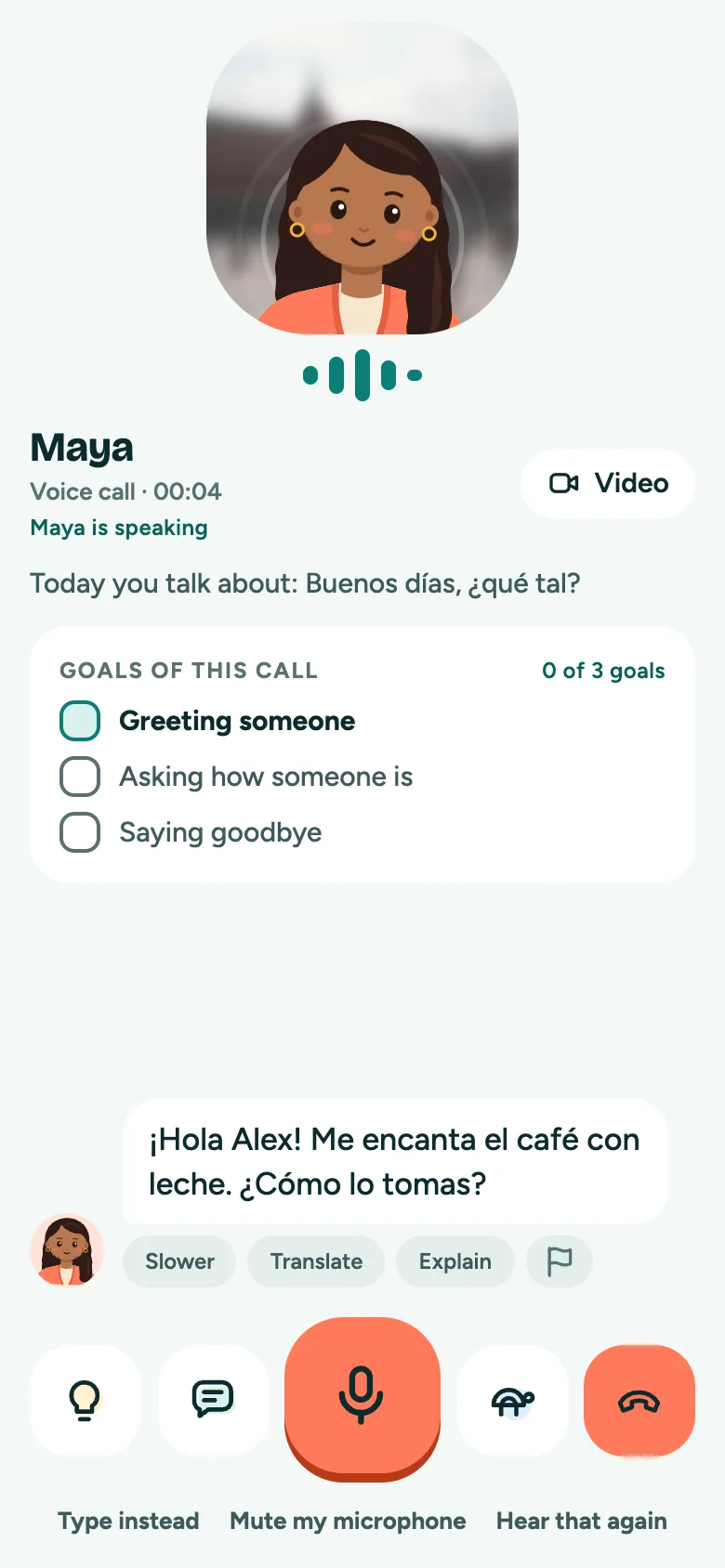
Chat, voice call and video call. A call is where a masculine accusative either comes out or does not, and where a correction lands in the moment.
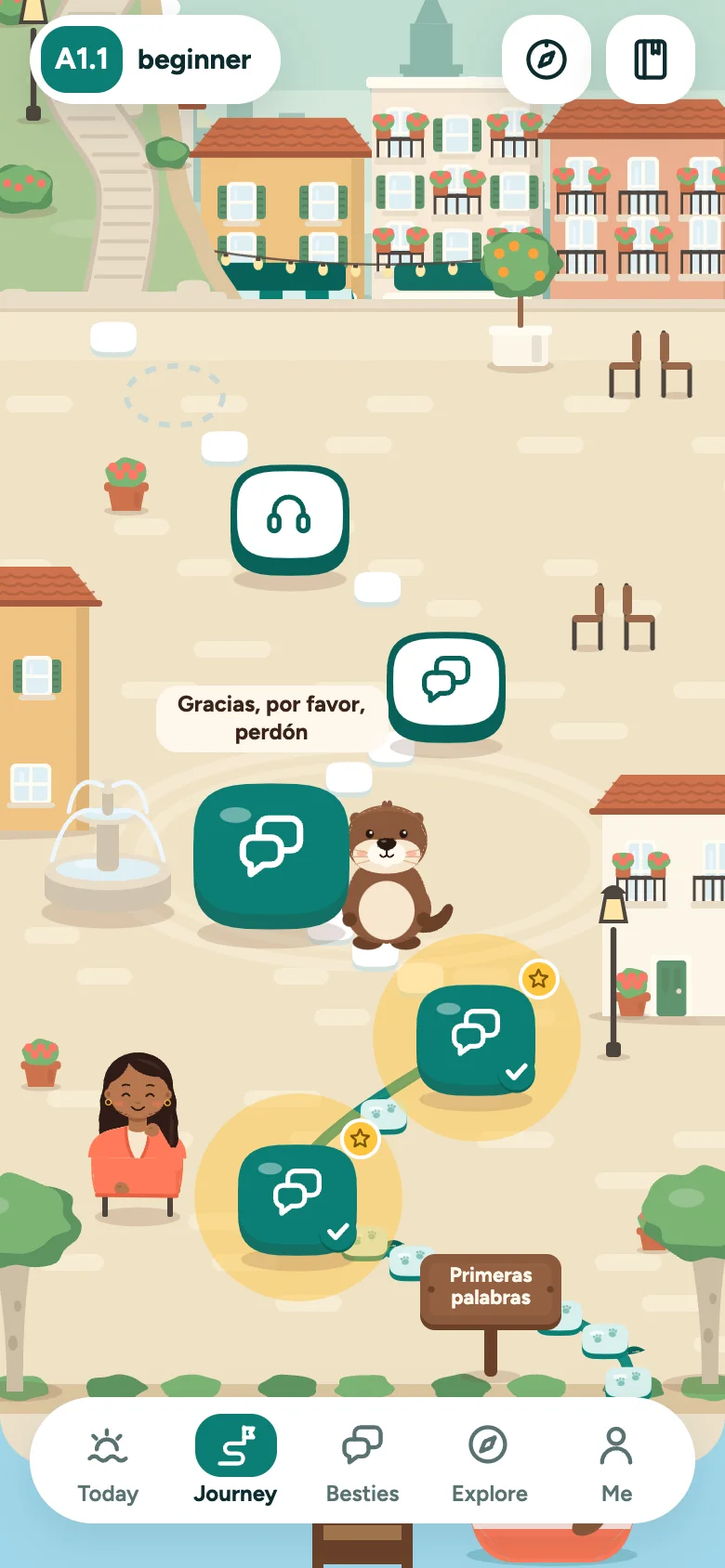
Start your 7 day free trial on iOS. The yearly plan ($79.99, or $6.67 a month) starts with 7 days free; monthly is $14.99; Family covers up to six people.
A 90 day plan to learn German fast
The plan assumes five sessions of about 15 minutes a week (75 minutes) plus 20 to 45 minutes of chat and calls, about 95 to 120 minutes a week in all. Thirteen weeks is about 65 sessions, so you finish Pre A1, complete most of the first A1 step and reach the start of the accusative. Sessions below are counted at five a week.
| Weeks | Sessions | Focus | Each week | Hurdle you train |
|---|---|---|---|---|
| 1 to 6 | 1 to 30 | Pre A1: greetings, the alphabet, the kiosk, asking for help | 5 sessions, 2 short chats | Articles with nouns, simple sentences |
| 7 to 12 | 31 to 60 | A1 step 1: who you are, ordering, directions, family | 5 sessions, 2 voice calls | Verb second, gender at the counter, du and Sie |
| 13 | 61 to 65 | Shopping | 5 sessions, 3 calls, one reading | The accusative begins |
Checkpoints. Day 30 (about session 21): you can greet, spell your name, buy something at a kiosk and say sorry. Day 60 (about session 43): you can order at a counter with Was möchten Sie? Ich nehme .... Day 90: you can talk about yourself, ask the way and shop with Ich suche .... The bracket (session 67) and your first Perfekt (session 87) come in the weeks right after, so keep going. If you miss a checkpoint, repeat the last unit; the course recycles.
For the method, see how to practise speaking a new language. Record yourself saying the twelve case sentences above, then listen back with the article in mind.
Exams and levels
The CEFR (A1 to C2) is the common scale, and LingoBestie German runs Pre A1 to B1, the levels the Goethe-Zertifikat exams test at A1 and B1. For format and dates use goethe.de; fees are set per country, so check the price for your test centre. The app's own exam practice covers DELE, DELF, DALF, IELTS, TOEFL iBT and JLPT, which matters if you study those languages too.
Frequently asked questions
What is the best app to learn German for beginners? LingoBestie, if you want to speak from the first session: Pre A1 to B1 in 450 guided sessions of about 15 minutes, with chat and calls on top. Pick Preply if you want a human teacher, or Babbel for a classic course with a free trial lesson. The score table above shows where each wins.
What is the best free app to learn German? Nicos Weg from Deutsche Welle is a free video course for A1 to B1, and Duolingo's courses are free to start. Busuu, LingQ and LingoBestie offer free starts too. Combine a free course with one speaking tool, since free video alone will not make you produce German aloud.
Babbel or Duolingo for German? Babbel is built as a structured course, from absolute beginners to upper intermediate, with explained grammar and a free trial lesson. Duolingo is free to start and good for a daily habit. For grammar you can follow, choose Babbel; for the cheapest start, Duolingo. Add speaking practice with either.
Is Duolingo enough to learn German? Duolingo's listing says every course is free, with Super as an optional upgrade. That makes it a good first step and a daily habit. To produce sentences aloud and have the cases explained, add a conversational tool or tutor. Our Duolingo vs LingoBestie page compares them in detail.
Can you learn German with an app alone? You can reach a comfortable A1 to B1 with a structured app if you speak aloud every day, because production is what builds case endings. Many learners add a weekly tutor lesson or a language exchange for unscripted talk. The 90 day plan above shows a realistic weekly routine.
What is the best app to practise German speaking? For speaking, choose an app that makes you talk in the first session and keeps going with live replies. LingoBestie does this by chat, voice call and video call with a bestie who remembers you; Preply gives a human tutor; Praktika offers AI voice chat. See our guide to AI language tutors.
Is German hard for English speakers? Vocabulary is easy because the languages share Germanic roots. The hard parts are gender, four cases and verb position, and each is learned by saying sentences, not reading tables. Only the masculine changes in the accusative, which shrinks the problem a lot. Most learners find it manageable with daily speaking.
How do I remember der, die, das? Learn every noun with its article. Nouns ending in -ung, -heit, -keit, -schaft and -ion are feminine (die), words ending in -chen and -lein are neuter (das), and days, months and seasons are masculine (der). These are rules of thumb with exceptions, so treat them as hints.
What is the best way to learn German as a beginner? Short, frequent speaking practice with a clear path beats long, rare sessions. Our plan uses five sessions of about 15 minutes a week plus chat and calls. Learn nouns with articles, meet the accusative before the dative, and leave the genitive for later, since von does its job in speech.
How long does it take to reach B1? Cambridge English gives an approximate 350 to 400 guided learning hours for B1, counted from zero. LingoBestie's German path has 450 guided sessions through B1, and chat, calls, Watch, Listen and Read add speaking time on top. Time depends on how much you speak between sessions. See how long it takes to learn a language.
Sources
All checked October 2026.
- LingoBestie German syllabus (
content/courses/de/syllabus.json, 450 sessions, session numbers and lesson titles) and the LingoBestie App Store listing. - Duolingo, App Store listing: every course free, 14 day Super trial. Super price reported in Lingoda's roundup.
- Preply, German tutors: over 3,000 tutors, sampled 50 minute lessons €20 to €40, trial lesson, money back guarantee.
- Babbel, Learn German; price from NerdWallet.
- Busuu, German course, Premium plans and Premium help.
- Praktika, homepage and App Store listing: German among its languages, about $8 a month.
- LingQ, German and free vs premium.
- Pimsleur, German; price in Lingoda's roundup.
- Nicos Weg by Deutsche Welle with the Federal Employment Agency, A1 to B1: lingoclub.com/nicos-weg.
- Goethe-Institut, exams.
- Cambridge English, guided learning hours: B1 350 to 400.
Related reading: best language learning apps, Duolingo vs LingoBestie, AI tutor vs human tutor, best app to learn English.