
On this page
- The 12 methods
- How the methods compare
- Why speaking feels hard
- Speaking plan by level
- Conversation practice for beginners: your first 3 conversations
- When you freeze: phrases that keep you talking
- Pronunciation by language: common traps
- Handling mistakes: choose your correction style
- A 4 week speaking calendar (printable)
- How to measure your progress
- Stuck? Fixing a plateau
- Speaking practice app: what to look for
- How LingoBestie builds speaking into every session
- FAQ
- Sources
By the LingoBestie editorial team. Updated October 2026. Disclosure: we make LingoBestie, an app with speaking practice, so it appears in this guide. The method scores are our editorial judgment on a visible rubric, not measurements. Every outside fact has a source and the date we checked it, and every statement about LingoBestie was checked against its App Store listing and the app.

You can finish the grammar chapter and the vocabulary deck and still go quiet when someone says "so, tell me about yourself". Reading and listening ask you to recognize words. Speaking asks you to produce them in real time while someone waits. The way through is to say the language out loud every day, in small safe doses, until it feels like talking instead of performing.
This guide gives you 12 ways to do that, grouped by who you are speaking with: a model you copy, yourself, or another person or an AI partner. Each has a 10 minute drill and the exact words to say. You also get scripts for A1, A2 and B1 in Spanish, French, German, Japanese, Korean and English, a phrase bank for the moments you freeze, a way to measure progress, and a 4 week calendar.
Quick start: a 10 minute daily routine | Minutes | What you do | Why | | :- | :- | :- | | 0 to 2 | Pick 5 lines you already studied. Say each one out loud, twice, slowly. | Warm the mouth up on words you know. | | 2 to 5 | Shadow one 30 second clip: say it half a beat behind the speaker. | Borrow native rhythm. | | 5 to 8 | Answer three questions out loud with your phone recording. | Real output with no audience. | | 8 to 10 | Play back one answer. Fix one thing. Say it again. | A single correction, not twenty. | Do this for 28 days and you will have said several hundred spoken sentences, more speaking than most weekly lessons leave room for. The calendar is below.
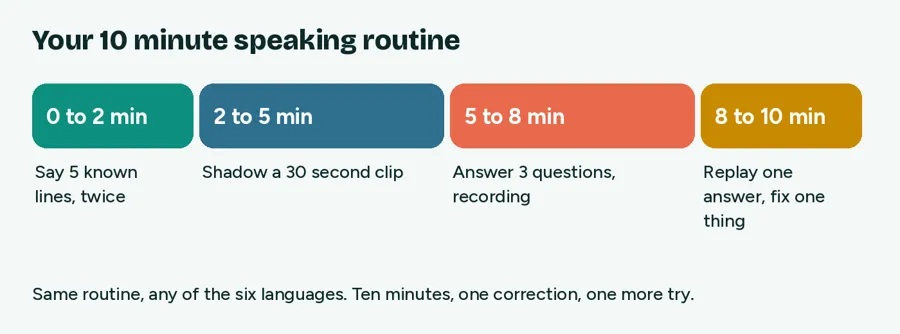
Jump to: the 12 methods · how they compare · scripts by level · your first 3 conversations · when you freeze · pronunciation · 4 week calendar · measure progress · plateaus · speaking practice apps
The 12 methods
Each method has a level fit (CEFR is the European A1 to C2 scale; see the Council of Europe level descriptions), the tools you need, and a drill with a clock on it. The methods are grouped by who you are speaking with, not ranked. Scores for effort and payoff come from the rubric in the next section: they are our editorial judgment after weighing the research and what holds up in practice, and they are not a measurement.
Songs are not on the list. Singing along is a fun way to train rhythm and listening, but you rarely produce your own sentences, so we treat it as a bonus to shadowing: pick a slow song, read the lyrics, and shadow the chorus.
Group 1: copy a model
1. Say it back
What it is. You hear a line from a native voice, pause, and say it back in your own voice with the same rhythm. It is the lowest effort way to start producing, because someone else did the hard part of choosing the words.
10 minute drill. Take 8 short lines. For each: listen once without speaking, listen again and mouth it silently, say it out loud, then say it again from memory with the audio paused. Spend about 75 seconds per line.
Say this (Spanish, A1). "Hola, me llamo Ana. Soy de Canadá. Vivo en Toronto." Then swap in your own name and city.
Level fit. Pre A1 to A2. Tools. Any course with native audio, or a podcast with a transcript. Effort 2, payoff 6.
2. Shadowing
What it is. You play a native recording and speak along with it, a fraction of a second behind, copying speed, stress and melody. It trains the physical mechanics of speech, which is why it helps with sounds that feel awkward: the Spanish rolled r, German ö, Japanese pitch accent, the Korean tensed consonants. The evidence base is small classroom studies, and we found no large trial, so treat it as a strong craft tip rather than settled science. Hamada (The Language Teacher, 2014) followed 56 Japanese first year university students over eight lessons and reported listening gains for the group that shadowed after listening; Sari and Jaya (English Community Journal, 2025) concluded that shadowing improved speaking fluency and pronunciation accuracy in Indonesian EFL learners (both checked October 2026).
10 minute drill. Choose a 30 second clip at your level. Minute 1 to 2: listen and read the transcript. Minute 3 to 4: shadow with the transcript in front of you. Minute 5 to 8: shadow without it, four times. Minute 9 to 10: record your best take.
Say this (German, A2). Clip: "Entschuldigung, wie komme ich zum Bahnhof?" Shadow it until the stress lands on "Bahnhof" without thinking.
Level fit. A1 to B2. Tools. Short audio with a transcript. Effort 5, payoff 7.
3. Read aloud
What it is. You read a printed text out loud. You get no help from memory, which is the point: you practice the link between spelling and sound while your eyes carry the grammar for you and your mouth does the work.
10 minute drill. Pick a 100 word paragraph. Read it slowly and mark every word you stumble on. Read it again, only fixing the marked words. Read it a third time at the speed of a calm radio host.
Say this (French, A2). "Le samedi, je vais au marché avec ma sœur. On achète des légumes, du fromage et du pain." Watch the liaison in "on achète" and the silent final consonants.
Level fit. A1 to B1. Tools. Graded readers, or books at your level. Effort 3, payoff 5.
4. Record and compare
What it is. You record yourself saying a line, then play the native version and your version one after the other. It is the closest thing to a tutor you can run on your own. Hearing your own voice feels unusual at first, and after a few sessions it becomes the most useful minute of the routine.
10 minute drill. Record one native line. Record yourself. Compare and note one difference only (stress, a vowel, speed). Re-record to fix that one thing. Do this for three lines. Keep the files and play the first recording again after four weeks: the difference is the motivation.
Say this (Korean, A1). 「안녕하세요. 만나서 반갑습니다.」 Listen for how 반갑습니다 is pronounced, roughly 반갑씀니다: the ㅂ in 습 turns into ㅁ before ㄴ and the ㅅ is tensed.
Level fit. A1 to B2. Tools. Your phone's voice memo app. Effort 4, payoff 7.
Group 2: speak on your own
5. Narrate your day
What it is. You describe what you are doing as you do it, in short sentences. It forces you to use the vocabulary of your real life, which is the vocabulary you most need.
10 minute drill. While cooking or tidying, say what you are doing: five minutes in present tense, then five minutes telling what you did earlier today in the past tense. When you hit a word you do not know, say a simple word instead, then look it up afterwards and put it on a list.
Say this (Japanese, A2). 「今、コーヒーを入れています。」「さっき、洗濯をしました。」
Level fit. A1 to B1. Tools. None. Effort 3, payoff 7.
6. Think aloud in the language
What it is. You narrate your own decisions in the language: what to cook, what to answer, what to do first. It turns the language from a subject into a working tool.
10 minute drill. On a short walk, plan your day in the language. Whenever you are stuck, say "no sé cómo se dice" (or the equivalent from the phrase bank below) and move on. Look the gaps up at home.
Say this (Spanish, B1). "Primero tengo que contestar unos correos. Después, si me da tiempo, voy al gimnasio."
Level fit. A2 to C1. Tools. None. Effort 2, payoff 5.
7. Speak to a pet or a mirror
What it is. It sounds silly and it works, because the audience is perfectly kind. Eye contact with yourself in a mirror also lets you watch your mouth shape sounds.
10 minute drill. Pick one topic (introduce yourself, explain your job). Say it to the mirror for 3 minutes, then say it again with the lines half remembered, then say it while walking around the room.
Say this (Korean, A1). 「저는 학생이에요. 서울에서 한국어를 공부해요.」
Level fit. Pre A1 to A2. Tools. A mirror or a very tolerant cat. Effort 1, payoff 5.
8. Roleplay a scene
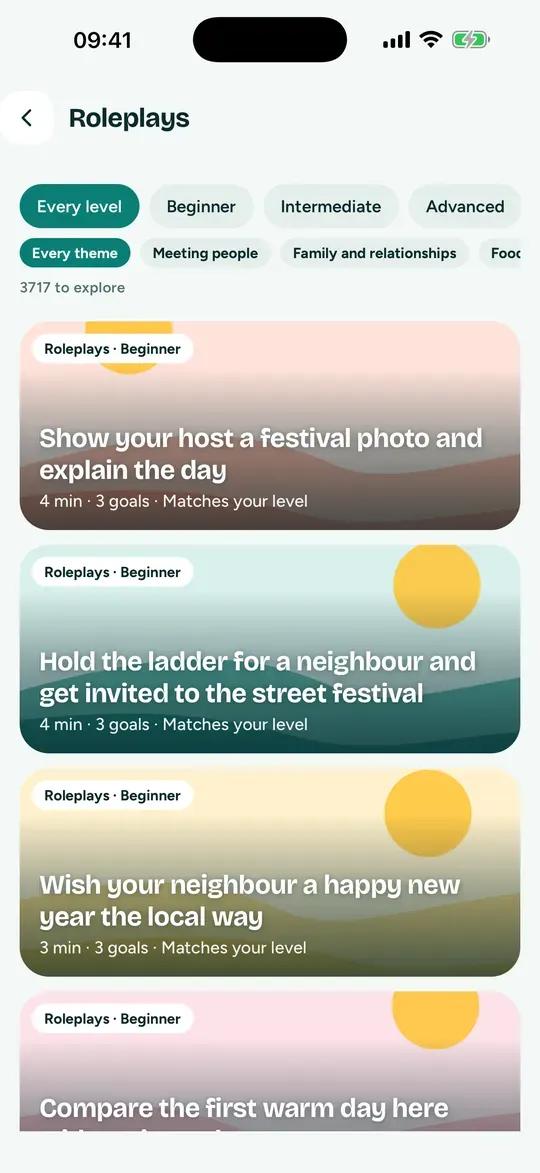
What it is. You play both sides of a real situation: ordering coffee, checking in at a hotel, calling a landlord. It moves you from isolated sentences to the back and forth rhythm of conversation, which is the part that makes people freeze.
10 minute drill. Write a six line scene. Say the other person's line, then your reply. Run it three times, changing one detail each time (the drink, the price, a problem). On the third pass, close your notes.
Say this (Spanish, A1). "Buenos días. Un café con leche, por favor." "¿Algo más?" "No, gracias. ¿Cuánto es?"
Level fit. A1 to B1. Tools. A script, or a course that runs roleplays. Effort 4, payoff 7.
Group 3: speak with someone
9. Phone-style call with an AI bestie
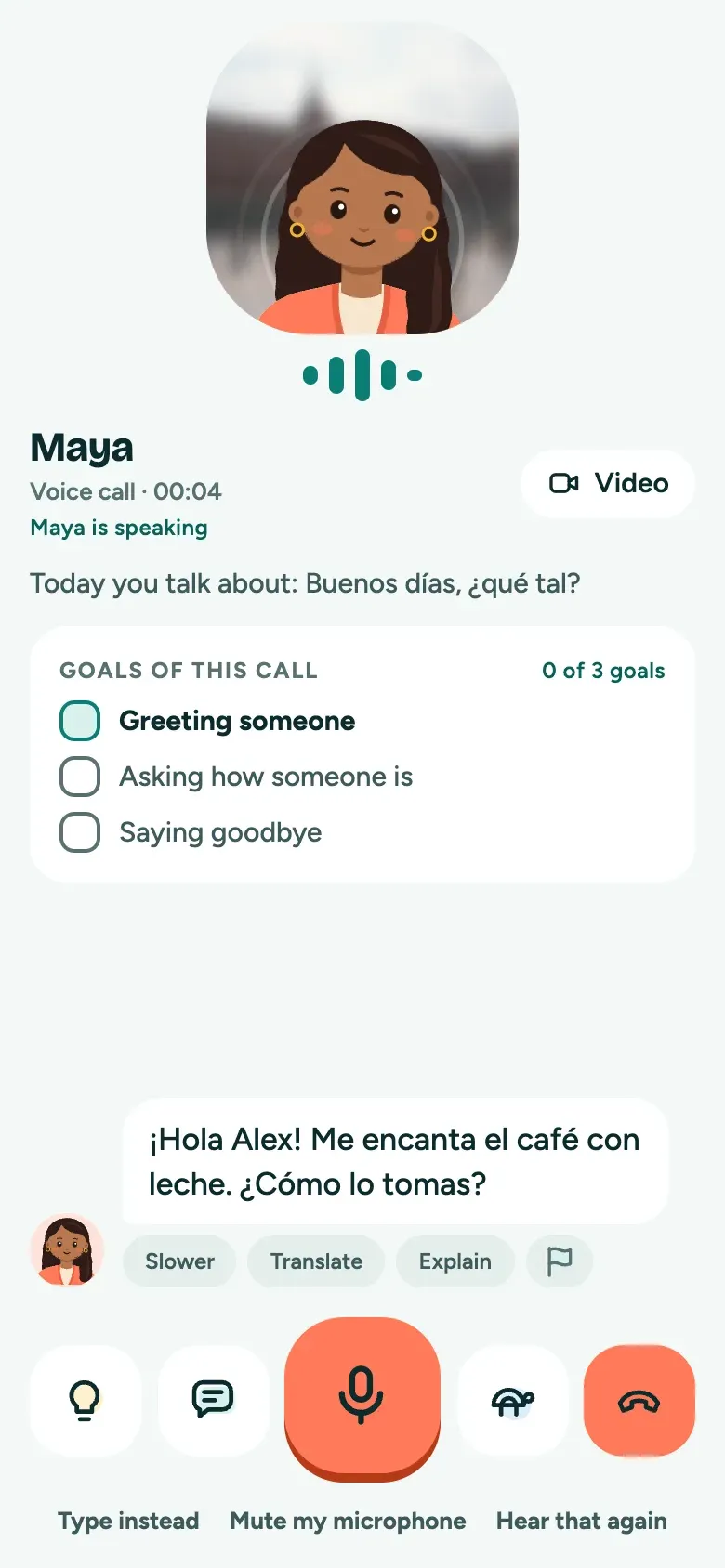
What it is. A voice conversation with an AI partner that answers in real time, at your level, without judging. It is the closest thing to a real conversation you can have at 11 pm in your pajamas. It works best when the app adjusts to your level and you keep speaking out loud instead of typing.
10 minute drill. Decide a topic before you call ("my weekend"). Make the call, speak in full sentences, and ask the bestie one question back. Afterwards, write down two phrases you were missing.
Say this (English, B1). "I'd like to practice telling a story about a trip. Can you ask me follow-up questions?"
Level fit. A1 to B2, with an app that adapts to your level. Tools. An app with voice calls; see the AI language tutor guide. Effort 3, payoff 8.
10. Voice notes
What it is. You send audio messages instead of texts, to a friend, a language partner or yourself. You get the pressure of "someone will hear this" without needing the other person to respond right now.
10 minute drill. Record a 60 second voice note answering "What did you do this weekend?" Listen once. Re-record it better. Send the second one. Repeat with a different question.
Say this (French, A2). "Ce week-end, je suis allé au parc avec des amis. Il faisait beau, alors on a fait un pique-nique."
Level fit. A2 to B2. Tools. A messaging app and a patient friend. Effort 3, payoff 6.
11. Tutor session
What it is. A paid one to one lesson with a human teacher. Nothing replaces a person who hears your mistakes and tells you which of them matter. The cost is money and scheduling, and your own talking time depends on how you run the lesson: if you speak for about a fifth of a 30 minute lesson, that is roughly six minutes, which is why we suggest sending your tutor a plan (our estimate, not a measured figure). On italki, the Spanish page lists more than 2,000 tutors at $4 to $60 an hour depending on experience and lesson format (italki, checked October 2026). Preply lists more than 100,000 tutors across subjects, with a 25 or 50 minute trial lesson, and prices that vary by tutor (Preply, checked October 2026).
10 minute drill (the part you do before the lesson). Send your tutor three topics. Prepare five sentences for each. Record the lesson if allowed. Afterwards, redo the two moments where you got stuck.
Say this (German, B1). "Ich möchte heute üben, meine Meinung zu begründen. Können Sie mich unterbrechen, wenn ich einen Fehler mache?"
Level fit. All levels, best from A2. Tools. italki, Preply and similar marketplaces. Effort 6, payoff 7.
12. Language exchange
What it is. You swap time with a native speaker who is learning your language: half in theirs, half in yours. It is free in money and costs coordination. It works best once you can hold a 10 minute conversation, because before that your partner ends up teaching you for free. Meetups and conversation groups are the same idea with more people.
10 minute drill. Prepare three questions and one story. In the session, ask your three questions, tell your story, and ask for one correction at the end rather than during.
Say this (Japanese, B1). 「最近、何か面白いことがありましたか。」
Level fit. A2 to C1. Tools. Exchange apps and local meetups. Effort 7, payoff 5.
How the methods compare
The scoring rubric. Payoff is the sum of three scores from 1 to 3, one per question: how much spoken output you get per 10 minutes (Output), how quickly you find out what you got wrong (Feedback), and how likely you are to do it again tomorrow (Repeat). The maximum is 9. Effort is a separate 1 to 10 judgment of setup, scheduling and willpower. We make LingoBestie, so we show the working: you can disagree with a score and recompute the sum.
| Method | Output (1 to 3) | Feedback (1 to 3) | Repeat (1 to 3) | Payoff (3 to 9) | Effort (1 to 10) |
|---|---|---|---|---|---|
| Say it back | 2 | 1 | 3 | 6 | 2 |
| Shadowing | 3 | 2 | 2 | 7 | 5 |
| Read aloud | 2 | 1 | 2 | 5 | 3 |
| Record and compare | 2 | 3 | 2 | 7 | 4 |
| Narrate your day | 3 | 1 | 3 | 7 | 3 |
| Think aloud | 2 | 1 | 2 | 5 | 2 |
| Pet or mirror | 2 | 1 | 2 | 5 | 1 |
| Roleplay a scene | 3 | 2 | 2 | 7 | 4 |
| Call with an AI bestie | 3 | 2 | 3 | 8 | 3 |
| Voice notes | 2 | 2 | 2 | 6 | 3 |
| Tutor session | 2 | 3 | 2 | 7 | 6 |
| Language exchange | 2 | 2 | 1 | 5 | 7 |
A call with an AI partner scores 2 on feedback because the feedback is instant but it is not a trained human ear; a tutor scores 3. The call earns its 8 on output and repeatability: you can do it on any day, at any hour, for as long as you like.
| Method | Cost | Feedback quality | Anxiety level | Best CEFR stage |
|---|---|---|---|---|
| Say it back | Free to low | Medium (model to copy) | Very low | Pre A1 to A2 |
| Shadowing | Free | Low alone, high with recording | Low | A1 to B2 |
| Read aloud | Free | Low | Very low | A1 to B1 |
| Record and compare | Free | Medium | Medium | A1 to B2 |
| Narrate your day | Free | None | Very low | A1 to B1 |
| Think aloud | Free | None | Very low | A2 to C1 |
| Pet or mirror | Free | None | Very low | Pre A1 to A2 |
| Roleplay a scene | Free to low | Medium with an app | Low | A1 to B1 |
| Call with an AI bestie | Subscription | High, instant | Low | A1 to B2 |
| Voice notes | Free | Depends on the friend | Medium | A2 to B2 |
| Tutor session | Varies by tutor: about $4 to $60 per hour on italki's Spanish page (italki and Preply, checked October 2026) | Highest | Medium to high | A2 and up |
| Language exchange | Free | Medium, uneven | Medium to high | A2 to C1 |
- Payoff (3 to 9)
- Effort (1 to 10)
| Payoff (3 to 9) | Effort (1 to 10) | |
|---|---|---|
| AI bestie call | 8.0 | 3.0 |
| Narrate your day | 7.0 | 3.0 |
| Record and compare | 7.0 | 4.0 |
| Roleplay a scene | 7.0 | 4.0 |
| Shadowing | 7.0 | 5.0 |
| Tutor session | 7.0 | 6.0 |
| Say it back | 6.0 | 2.0 |
| Voice notes | 6.0 | 3.0 |
| Pet or mirror | 5.0 | 1.0 |
| Think aloud | 5.0 | 2.0 |
| Read aloud | 5.0 | 3.0 |
| Language exchange | 5.0 | 7.0 |
What to take from it. The cheap methods with a high score (a bestie call, narrating, recording, roleplay) are where a daily routine lives. Tutors and exchanges cost more in scheduling, and that is fine: do them weekly and the cheap ones daily.
Why speaking feels hard
Recognizing "¿Dónde está la estación?" when you read it takes almost no effort. Producing it means pulling the words from memory, ordering them and moving your mouth inside about a second. Pulling information out of memory strengthens it far more than rereading: students who practised retrieving word lists kept much more a week later than students who restudied them (Karpicke and Roediger, Science, 2008). Speaking is retrieval with an audience, and every spoken sentence is one more rep. The audience adds anxiety: Horwitz, Horwitz and Cope (Modern Language Journal, 1986) described communication apprehension and fear of negative evaluation as the core of foreign language classroom anxiety, and the simplest remedy is lowering the stakes. Speak to a recorder before a person, use words you already know, and hear yourself back. You do not need more vocabulary to start. You need to use the 100 words you have.
Speaking plan by level
Match the work to your level. Practicing B1 conversation at A1 produces the freeze, and recycling hello and goodbye at A2 produces a plateau. Time to reach each level varies a lot by language and learner; see how long it takes to learn a language. If you want a course for one language, we have a guide for each: Spanish, French, German, Japanese, Korean and English.
Pre A1 and A1: your first 100 phrases
The goal is a set of lines you can say without thinking. Use say it back, read aloud and the mirror. Spend 10 minutes a day. Aim for 10 new lines a week and recycle all the old ones.
| Language | Introduce yourself | Ask for something |
|---|---|---|
| Spanish | Hola, me llamo Ana. Soy de Canadá. Vivo en Toronto. Trabajo como diseñadora. | ¿Me puede ayudar, por favor? ¿Dónde está el baño? |
| French | Bonjour, je m'appelle Ana. Je viens du Canada. J'habite à Toronto. Je suis designer. | Pourriez-vous m'aider, s'il vous plaît ? Où sont les toilettes ? |
| German | Hallo, ich heiße Ana. Ich komme aus Kanada. Ich wohne in Toronto. Ich arbeite als Designerin. | Können Sie mir bitte helfen? Wo ist die Toilette? |
| Japanese | はじめまして。アナです。カナダから来ました。トロントに住んでいます。デザイナーです。 | すみません、手伝ってもらえますか。お手洗いはどこですか。 |
| Korean | 안녕하세요. 저는 아나예요. 캐나다에서 왔어요. 토론토에 살아요. 디자이너예요. | 도와주시겠어요? 화장실이 어디예요? |
| English | Hi, my name is Ana. I'm from Canada. I live in Toronto. I work as a designer. | Could you help me, please? Where is the restroom? |
Today's 10 minutes: pick one row, say the first column three times with each sentence slowly, then close your eyes and say it from memory.
A2: stories and questions
Now you stitch sentences into short stories and start asking questions back. Add shadowing, narration, record and compare, and voice notes. Target: a 60 second story about yesterday, and three questions you can ask anyone.
| Language | A 60 second story starter | Questions to ask back |
|---|---|---|
| Spanish | Ayer me levanté tarde porque no oí el despertador. Tomé un café y salí corriendo. | ¿Y tú? ¿Qué hiciste ayer? ¿Dónde vives? |
| French | Hier, je me suis levé en retard parce que je n'ai pas entendu mon réveil. J'ai pris un café et je suis parti en courant. | Et toi ? Qu'est-ce que tu as fait hier ? Tu habites où ? |
| German | Gestern bin ich zu spät aufgestanden, weil ich den Wecker nicht gehört habe. Ich habe schnell einen Kaffee getrunken und bin losgelaufen. | Und du? Was hast du gestern gemacht? Wo wohnst du? |
| Japanese | 昨日は朝寝坊してしまいました。目覚まし時計が聞こえなかったからです。急いでコーヒーを飲んで、家を出ました。 | あなたはどうですか。昨日は何をしましたか。どこに住んでいますか。 |
| Korean | 어제는 늦게 일어났어요. 알람 소리를 못 들었거든요. 커피를 급하게 마시고 집을 나갔어요. | 어제 뭐 했어요? 어디에 살아요? 요즘 어떻게 지내세요? |
| English | Yesterday I woke up late because I didn't hear my alarm. I had a quick coffee and ran out the door. | What about you? What did you do yesterday? Where do you live? |
Register note: the Spanish, French and German questions use the informal "tú", "tu" and "du" forms for a friend; with a stranger or at work, switch to "usted", "vous" and "Sie". The Korean questions use the polite 요 ending throughout, the safe default for a learner. The Japanese uses the polite です and ます forms.
B1: opinions and plans
At B1 the job is to hold a position, give a reason and make a plan. Add roleplays with a twist (a problem you must solve), calls with an AI partner, tutor sessions and exchanges. Target: a 90 second opinion with two reasons and one concession.
| Language | Opinion with a concession | Plan |
|---|---|---|
| Spanish | En mi opinión, trabajar desde casa tiene más ventajas que desventajas. Por un lado, no pierdes tiempo en el transporte; por otro lado, hablas menos con tus compañeros. | El año que viene quiero viajar a Perú, así que voy a ahorrar cada mes. |
| French | À mon avis, le télétravail a plus d'avantages que d'inconvénients. D'un côté, on gagne du temps ; de l'autre, on parle moins avec ses collègues. | L'an prochain, je voudrais voyager au Pérou, donc je vais économiser chaque mois. |
| German | Meiner Meinung nach hat Homeoffice mehr Vorteile als Nachteile. Einerseits spart man Zeit, andererseits spricht man weniger mit den Kollegen. | Nächstes Jahr möchte ich nach Peru reisen, deshalb spare ich jeden Monat Geld. |
| Japanese | 私は在宅勤務のほうがいいと思います。通勤の時間がなくなるからです。一方で、同僚と話す機会が減るのが残念です。 | 来年はペルーに旅行したいので、毎月貯金するつもりです。 |
| Korean | 제 생각에는 재택근무가 장점이 더 많은 것 같아요. 출퇴근 시간이 없어지니까요. 그래도 동료와 얘기할 기회가 줄어서 아쉬워요. | 내년에 페루에 여행 가고 싶어서 매달 저축할 거예요. |
| English | In my opinion, working from home has more advantages than disadvantages. On the one hand you save commuting time; on the other hand you talk to colleagues less. | Next year I want to travel to Peru, so I'm going to save money every month. |
Speaking for an exam? The same structure (answer, reason, example) carries into test answers. See IELTS speaking practice, the DELE exam prep guide and the JLPT N5 and N4 study guide.
Conversation practice for beginners: your first 3 conversations
Beginners often wait until they "know enough" before they try a conversation. Three tiny conversations are enough to start, and each one is built from lines in the A1 table above. Run each one with a model voice, an AI partner or a patient friend, and repeat it until it feels easy before you move on.
- Say who you are (about 1 minute). Greeting, your name, where you are from, what you do. Practice it until you can say it without looking. Ask one question back: "¿Y tú?"
- Ask for something (about 2 minutes). Order a drink, ask where the restroom is, ask someone to repeat. Use the "Ask for something" column and the phrase bank below. Change one detail on each pass.
- Talk about your day (about 3 minutes). Two sentences about today, two about yesterday, one question for the other person. This is the A2 story starter, shortened.
When all three feel easy, add a fourth with a twist: something goes wrong (the coffee is cold, the train is late) and you have to say so politely.
When you freeze: phrases that keep you talking
Freezing is normal. The skill that keeps beginners in the conversation is to buy a second, ask for the missing word, or describe around it, and all three can be learned in an afternoon. Say each phrase out loud, then write down the one you will use first.
| Language | Buy time | Ask for the word | Ask them to slow down | Describe around a word |
|---|---|---|---|---|
| Spanish | Bueno... A ver... | ¿Cómo se dice «...» en español? | ¿Puede hablar más despacio, por favor? | Es algo que se usa para... |
| French | Eh bien... Alors... | Comment dit-on « ... » en français ? | Pouvez-vous parler plus lentement, s'il vous plaît ? | C'est quelque chose qu'on utilise pour... |
| German | Also... Mal sehen... | Wie sagt man „..." auf Deutsch? | Können Sie bitte langsamer sprechen? | Das ist etwas, das man benutzt, um ... |
| Japanese | えっと... そうですね... | 「...」は日本語で何と言いますか。 | もう少しゆっくり話していただけますか。 | ...ときに使うものです。 |
| Korean | 음... 그러니까... | 이건 한국어로 뭐라고 해요? | 조금만 천천히 말해 주세요. | ...할 때 쓰는 거예요. |
| English | Well... Let me think... | How do you say "..." in English? | Could you speak a bit more slowly, please? | It's something you use to... |
Practice describing around a word: pick five objects in the room, forget their names on purpose, and explain each in one sentence using the last column. This is the skill that keeps a conversation going when the vocabulary runs out.
Pronunciation by language: common traps
You do not need perfect pronunciation, you need to be understood and to keep improving. Most learners get the biggest gain by fixing one trap at a time with the record and compare method: record the line, listen for the trap, fix it, record again. Slow the native audio down with your phone's playback speed, and use short pairs of similar words (minimal pairs) to hear the difference.
| Language | Common traps to listen for |
|---|---|
| Spanish | The rolled r (pero and perro are different words); five pure vowels that do not glide; b and v sounding the same in most places. |
| French | Nasal vowels (an, on, in); the French r; silent final consonants and the liaison ("vous avez" links the s to the a). |
| German | The vowels ö and ü; the two ch sounds (ich and ach); final consonants sounding voiceless (Hund ends with a t sound). |
| Japanese | Pitch accent; long and short vowels (おばさん and おばあさん are different people); double consonants (きて and きって are different words). |
| Korean | Plain, tense and aspirated consonants (가, 까, 카); final consonants and linking (반갑습니다 sounds like 반갑씀니다). |
| English | The th sounds; vowel length (ship and sheep); stress inside words, which can change the meaning of a word like "record". |
Handling mistakes: choose your correction style
How you get corrected matters as much as how often. Three styles, and who they suit:
- Right away. Someone steps in the moment the mistake lands. Feedback is fast, but it breaks your train of thought and raises anxiety for many beginners. Best for pronunciation drills and short, controlled lines.
- A nudge, then an explanation. You get a quick pointer on the key phrases, and the rest waits. A good middle path for A2 and B1 when you want some correction without losing the thread.
- At the end. You finish the whole thought and hear a summary after. This keeps fluency intact and is the sweet spot for anxious speakers and for the first weeks of a new language.
Decide on a style before each session. When you are alone, set it up on purpose: record yourself and review at the end, or write down only the one error that confused the meaning. In LingoBestie you choose among three styles called Gentle (tell me at the end), Balanced (nudge me, then explain) and Direct (tell me right away), and your bestie shows you the better way to say it and lets you try again.
A 4 week speaking calendar (printable)
Ten minutes a day, six days a week, with one longer session on day 7. Use the routine from the quick start box as the base and add one method per day. Download the printable calendar (PDF).
| Week | Mon | Tue | Wed | Thu | Fri | Sat | Sun (20 to 30 min) |
|---|---|---|---|---|---|---|---|
| 1: Warm up | Say it back | Say it back | Read aloud | Mirror | Say it back | Narrate your day | Record 5 lines |
| 2: Rhythm | Shadowing | Shadowing | Say it back | Narrate your day | Shadowing | Roleplay a scene | Record and compare vs week 1 |
| 3: Conversation | Roleplay a scene | AI bestie call | Voice notes | Shadowing | AI bestie call | Think aloud | Tutor session or exchange |
| 4: Stretch | AI bestie call | Roleplay with a twist | Voice notes | Shadowing | AI bestie call | Think aloud | Record a 90 second story, compare with week 1 |
Rules of the calendar: never skip two days in a row, keep sessions short enough that you would do them on your worst day, and put the date and one sentence of what you said in your notes. On day 28, listen to your week 1 recording and score both with the table in the next section.
How to measure your progress
Progress in speaking is easy to miss because you change gradually. Two simple checks make it visible.
1. The week 1 versus week 4 recording test. Record yourself answering the same question in week 1 and in week 4 (for example "Tell me about your day yesterday"). Score each recording with this self-check. It is our own tool for tracking yourself, not a validated test.
| What to listen for | 1 point | 2 points | 3 points |
|---|---|---|---|
| Length | Under 30 seconds | 30 to 60 seconds | Over 60 seconds |
| Flow | You stop every few words | You stop at the end of each sentence | Short pauses, with fillers from the phrase bank |
| Clarity | You would need to repeat yourself | A listener follows most of it | A listener follows all of it the first time |
| Range | The same few words as before | Some new words from this month | New words and one new tense from this month |
| Fixing | Same error as week 1 | One week 1 error fixed | Your week 1 error is gone |
A total gain of two or more points between week 1 and week 4 is a clear sign the routine is working.
2. A CEFR can-do self-check. The Council of Europe describes what you can do at each level (level descriptions, checked October 2026). In plain words for speaking:
- A1: you can introduce yourself and ask and answer simple questions about where you live and what you have, if the other person speaks slowly and clearly.
- A2: you can handle short, routine exchanges (shopping, directions, your day), describe your family and your surroundings in simple terms, and talk about what you did yesterday.
- B1: you can cope with most situations when you travel, tell a story, describe an experience, and give brief reasons and opinions, without needing to prepare every line.
Tick the sentences you could do today with no notes. When you can tick all of one level, you are ready for the next.
Stuck? Fixing a plateau
You are stuck at A2. You can order coffee and tell yesterday's story, but nothing new is arriving. Add one new tense or one connector a week ("because", "but", "so") and use it in the narrate your day drill. Move from scripted lines to roleplays with a twist.
You speak fluently but make the same mistakes. Fluency has outrun accuracy. Switch to record and compare, fix one error type per week, and ask a tutor or an AI partner to correct only that one thing.
You can speak but cannot understand replies. Production has outrun listening. Add shadowing every day, use transcripts and slower audio, and replay the other speaker's lines in your roleplays until you can follow them at full speed.
You understand a lot but cannot speak. That is a retrieval gap, not a knowledge gap. Spend a week on say it back and the mirror with words you already know, then move to short voice notes.
You feel you are not improving. Run the week 1 versus week 4 test. Progress you cannot feel often shows up on the recording.
Speaking practice app: what to look for
A speaking practice app earns its place if it makes you produce sentences out loud. Look for five things: native audio for the lines you copy, a roleplay or call where you speak in full sentences, corrections you can adjust to your nerves, a level that adapts as you improve, and a way to listen back to yourself or review what you said. Free apps with speaking practice exist, and so do paid ones; the right choice depends on your goal and your budget. For a scored comparison with prices and sources, see the best language learning apps, and for AI conversation partners specifically, see the AI language tutor guide.
How LingoBestie builds speaking into every session
LingoBestie is built so speaking comes first. You speak in your first minute: your bestie always starts and gives you the words first, so you hear a line, say it back, and feel it click. Every speaking step also has a tap option, so a quiet train or a nervous day never blocks a session.
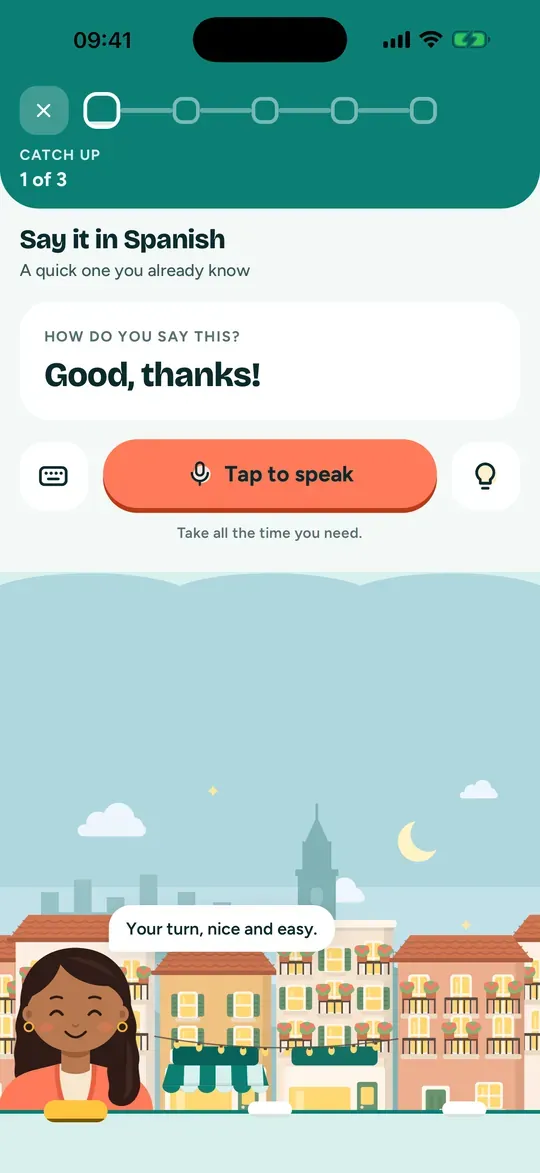
Here is what that looks like, using the methods above:
- A session has five beats: catch up, listen, warm up, live it in a roleplay and wrap up, about 15 minutes in total. That is say it back, shadowing and roleplay in a single sitting. The five beats are how the product is built, and the 10 minute routine in this guide is a solo drill you can run alongside them. About 450 sessions per language follow the official CEFR levels from your first hello to B1.
- Calls with your bestie. Nori the sea otter finds your match; then Maya, Theo, Kiko and Sam each bring their own home, job and humour. Chat, voice call and video call whenever you like, at your level. Your bestie remembers your week, your interview, the word you nearly had last time, and you can see and change what it knows.
- Your correction style, your choice: Gentle, Balanced or Direct, as described above.
- Real material. Watch real videos with timed transcripts, listen to podcasts and read books at your level, and tap any word to hear it. That is raw material for shadowing and reading aloud, in the same app.
- Words that stay: spoken review brings words back right on time, so they move from "I know this" to "I can say this".
- Six languages: English, Spanish, French, German, Japanese and Korean, each a full course. You learn with lessons and explanations in the language you think in, and the app interface comes in 15 languages.
LingoBestie launches on iOS first. Plus opens the full Journey, every bestie, video calls and exam practice, and your first 7 days on the yearly plan are free, with no payment today. For a Spanish-specific comparison, see the best app to learn Spanish; for the wider field, see the best language learning apps and the AI language tutor guide.
Other apps are adding speaking features too. Duolingo's blog describes Video Call and Roleplay as AI features of its Duolingo Max tier (Duolingo blog, checked October 2026); which languages and platforms get them changes over time, so check the app for your course. For a full side by side with sources, read Duolingo vs LingoBestie.
FAQ
How do I practice speaking a language by myself?
Use a short daily routine of 10 minutes: say lines out loud, shadow a clip, answer questions into a recorder and replay one answer. Methods 1 to 8 work completely alone, and the AI call, voice notes, tutor session and exchange add another voice. The calendar tells you which to use on which day.
Can I learn to speak without a partner?
Yes, for the first levels. Say it back, shadowing, narrating and recording give you plenty of output, and an AI partner adds a conversation. The missing piece is feedback from a trained ear, so add a tutor session now and then, for example once a month, to check what you cannot hear yourself.
How can I stop being afraid to speak a new language?
Lower the stakes first: speak to a recorder, a mirror or an AI bestie before a person. Fear of judgment is a well documented part of language learning (Horwitz, Horwitz and Cope, 1986). Then raise the stakes in small steps: a voice note to a friend, then a short tutor session.
How long until I can hold a conversation?
It depends on the language, your time and your starting point. As a guide, Cambridge English estimates roughly 180 to 200 guided learning hours to reach A2 and 350 to 400 to reach B1 (cumulative, approximate, written for English, checked October 2026; source). At 10 to 15 minutes of speaking a day, that is a long road, so combine speaking with listening and study. See how long it takes to learn a language for ranges by language, including Japanese and Korean.
How many minutes a day should I speak?
Ten focused minutes a day beats an hour once a week, because the mouth and memory get daily practice. If you have more time, spend 15 to 20 minutes and add a second method from the calendar. Aim for a session you would do on your worst day.
Why do I understand but cannot speak?
Understanding is recognition and speaking is retrieval, which is harder and needs its own practice. Say lines you already know out loud every day, then build up from say it back to short answers and voice notes. The plateau section above has a one week plan.
Is shadowing worth it?
Yes, for rhythm and pronunciation, especially with sounds your first language lacks. Research so far is mostly small classroom studies that report gains, so use it as one tool among several, 5 to 10 minutes a day.
What is the best way to practice speaking as a complete beginner?
Say it back. Choose a few phrases, hear a native model and repeat them until you can say them from memory. The A1 table above gives you a first set in six languages, and the three beginner conversations turn them into dialogue.
Can an app replace a human tutor for speaking practice?
An app gives you volume, patience and instant availability; a tutor gives you the sharpest eye for your individual mistakes. Most learners do best using a daily app routine and a weekly or monthly tutor session. See AI tutor vs human tutor.
Should I be corrected while I speak or after?
It depends on your level and your nerves. Beginners and anxious speakers usually do best with corrections at the end; pronunciation drills suit instant correction, and a nudge first, then an explanation, suits the stage in between.
What is a good speaking practice app?
Look first for neutral criteria: native audio, a roleplay or call where you speak in full sentences, corrections you can adjust, a level that adapts, and a way to review what you said. Then compare apps on price and languages in our best language learning apps guide. LingoBestie offers all five criteria, with a 7 day free trial on the yearly plan.
Sources
Questions in the FAQ reflect phrasing seen in search results for "how to practice speaking a language by yourself" and related queries (checked October 2026); they were rewritten, not copied.
- Karpicke, J. D. and Roediger, H. L. (2008). The Critical Importance of Retrieval for Learning. Science, 319(5865), 966 to 968. https://doi.org/10.1126/science.1152408 (checked October 2026)
- Horwitz, E. K., Horwitz, M. B. and Cope, J. (1986). Foreign Language Classroom Anxiety. The Modern Language Journal, 70(2), 125 to 132. https://www.jstor.org/stable/327317 (checked October 2026)
- Council of Europe. Common European Framework of Reference for Languages: level descriptions. https://www.coe.int/en/web/common-european-framework-reference-languages/level-descriptions (checked October 2026)
- Sari, D. K. and Jaya, A. (2025). The Effect of Shadowing Technique on Students' Speaking Fluency and Pronunciation Accuracy. English Community Journal, 9(1). A study of shadowing with Indonesian EFL learners. https://jurnal.um-palembang.ac.id/index.php/englishcommunity/article/view/9808 (DOI 10.32502/ecj.v9i1.9808, checked October 2026)
- Hamada, Y. (2014). The effectiveness of pre- and post-shadowing in improving listening comprehension skills. The Language Teacher, 38(1). https://jalt-publications.org/tlt/articles/3537-effectiveness-pre-and-post-shadowing-improving-listening-comprehension-skills (checked October 2026)
- italki, Spanish tutors page: more than 2,000 tutors listed (2,341 when checked), $4 to $60 per hour in its FAQ. https://www.italki.com/en/teachers/spanish (checked October 2026)
- Preply, Spanish tutors page: 100,000+ tutors, 25 or 50 minute trial lessons, prices vary by tutor. https://preply.com/en/learn/spanish (checked October 2026)
- Duolingo blog, Duolingo Max: Video Call and Roleplay. https://blog.duolingo.com/duolingo-max/ (checked October 2026)
- Cambridge English, Guided learning hours. https://support.cambridgeenglish.org/hc/en-gb/articles/202838506-Guided-learning-hours (checked October 2026)
- LingoBestie App Store listing and product facts (internal), updated 2026-10-31.
Image credits: illustrations and app screenshots by LingoBestie.