On this page
- Why the usual comparison misleads you
- How we chose what to compare
- Side by side: what each option gives you
- The cost per speaking minute calculator
- What the research says
- What humans do better
- What an AI bestie does well
- Where an AI bestie falls short, and how to use it well
- Four learner profiles and the blend for each
- When a tutor is not worth it
- A 12 week blended plan
- How to get more from tutor sessions
- Where each option fits in your week
- FAQ
- Sources
By the LingoBestie team. We priced every option from its own official page in October 2026 and checked every statement about LingoBestie against the app and its App Store listing. We did not run a learner study, and we say where our numbers are estimates.
The short verdict. For language learning, use an AI bestie every day for volume and a human tutor once a week for polish. (A "bestie" is what we call the AI friend you talk to in LingoBestie: a character with a name, a home, a job and a sense of humour, who chats, calls and teaches with you.) The bestie gives you many low-pressure speaking minutes for the price of a coffee a month. The tutor gives you what only a person can: a native ear for what sounds odd, a culture you can ask questions of, and the feel of an unpredictable conversation. Spend on both, in that order of frequency.
At a glance. A marketplace tutor costs roughly $65 per hour of your own speaking (at $26 an hour and a 40 percent speaking share). A group class platform lands near EUR 52 (Lingoda quotes euros). An AI bestie on LingoBestie Plus lands near $1.50 to $3.35, depending on the plan. Every price comes from an official page we link, the speaking shares are labelled estimates, and a sensitivity table below shows how the answer moves if you change them.
Why the usual comparison misleads you
Most "AI tutor vs human tutor" pages are written by someone who sells one of the two. Tutor marketplaces tell you a human is irreplaceable. App makers tell you the tutor is a luxury. We sell an app, so you should know our bias, and you should check our arithmetic. We kept the method simple so you can.
The number that matters for your wallet is not the price of a lesson. It is the price of the minutes in which you open your mouth. In a one hour lesson, the teacher explains, corrects, asks questions and fills silences, so a typical learner speaks for a minority of the hour. In a group class of three to five, your share is smaller again. In a chat or call with an AI bestie, the conversation is built around you answering.
So we compare cost per minute of learner speaking. It is a crude measure, because speaking is only part of learning a language. But it is the part most people under-buy, and the part where the price gap is largest.
How we chose what to compare
We picked the three ways readers actually spend money on speaking practice:
- A marketplace tutor (Preply, italki and similar), where the teacher sets the price and you book lesson by lesson.
- A group or scheduled class platform (Lingoda is the clearest example), where you buy a plan of classes.
- An AI bestie in an app (LingoBestie), where one subscription includes generous daily call and chat time.
Rules we held ourselves to:
- Only official pages count as price sources. Blogs and review sites disagree with each other by a factor of three, so we left them out of the numbers.
- Where a page gives an average, we say which one we picked and why. Where it gives a range, we show the range.
- Every assumption (how much of a lesson you speak, how many minutes a day you use the bestie) is written down so you can replace it with your own.
- The speaking shares (40 percent for a tutor lesson, 20 percent for a group class, 60 percent for a bestie conversation) are our estimates, not measured figures. Read the research section below for what is and is not known.
Side by side: what each option gives you
| Marketplace tutor | Group class platform | AI bestie (LingoBestie Plus) | |
|---|---|---|---|
| Price model | You pay per lesson, tutor sets the rate | Plan of classes, renews every four weeks | One subscription, monthly or yearly |
| Typical cost, from official pages | Preply lists $26 (native) and $23 (non-native) averages on its English page, $26 and $29 on its Spanish page. Lessons start from $3 on Preply and $4 on italki | About EUR 8.49 to EUR 15.99 per class on Lingoda's lower price ladder, depending on the plan | $14.99 a month, or $79.99 a year (about $6.67 a month) |
| Your speaking per week, under our assumptions | About 24 minutes from one weekly hour | About 36 minutes from three classes a week (a 12 class plan) | About 63 minutes at 15 minutes a day |
| Feedback type | A person's judgement: what sounds unnatural, why, and what to try | A teacher plus classmates, structured to a level | Gentle corrections in the style you pick: at the end, a nudge, or right away |
| Scheduling | Book a slot, time zones apply | Fixed class times, some flexible | Any minute of the day, including midnight |
| Nerves factor | Real. Some people freeze in front of a person | Real, plus an audience of classmates | Very low. Nobody is watching and you can retry at once |
| Memory of you | The tutor remembers if you keep the same one | Different teachers and classmates are common | Remembers your week, your job and the word you nearly had, and you can see and change it |
| Exams | Excellent for an examiner's feel | Good for structured exam courses | Practice in the official formats for DELE, DELF and DALF, IELTS, TOEFL iBT and JLPT N5 to N2 |
Assumptions behind the speaking figures. In a one hour tutor lesson you speak 40 percent of the time (24 minutes). In a Lingoda class of three to five you speak 20 percent (12 minutes). With the bestie you use 15 minutes a day and speak 60 percent of that (9 minutes a day, 63 a week). That 15 minute habit is our assumption, not a product figure. Plus currently allows up to 2 hours of practice a day, so 15 minutes sits well inside it. The Plus subscription also includes the lessons, the library and exam practice, so charging the whole subscription to speaking favours the bestie side. Keep that in mind when you read the gap.
The cost per speaking minute calculator
Cost per hour of your own speaking = price of one hour of the service, divided by the share of that hour in which you speak.
- Marketplace tutor. Preply's English page lists average hourly rates of $26 for native speakers and $23 for non-native speakers. Its Spanish page lists $26 and $29. The same Spanish page's FAQ says classes start from $3. We use $26 because it is the native-tutor hourly average that appears on both pages, and a full hour with a native speaker is what the other columns buy. At a 40 percent speaking share, one hour of speaking costs $26 divided by 0.4, which is $65.
- Group class platform. Lingoda's pricing page shows two euro price ladders for 60 minute live classes, renewing every four weeks. The page does not label the ladders, so we use the lower one, which runs from EUR 15.99 per class for a 5 class plan down to EUR 8.49 on a 40 class plan; the higher ladder runs from EUR 36.99 to EUR 18.99. We use the 12 class plan at EUR 10.49 per class (EUR 127.99 per four weeks). The page's group tab describes classes with 3 to 5 students, so we assume a 20 percent share (12 minutes). One hour of speaking costs EUR 10.49 divided by 0.2, which is about EUR 52. We keep euros because the page showed euro prices when we checked, and a conversion would add an assumption you cannot verify.
- AI bestie. LingoBestie Plus is $79.99 a year, which is $6.67 a month (the App Store shows your local price). At 15 minutes a day with a 60 percent speaking share, you speak 270 minutes, or 4.5 hours, a month. $6.67 divided by 4.5 is about $1.48 per hour. On the monthly plan at $14.99, the same use costs about $3.33 per hour.
- Cost per hour of your own speaking
| Cost per hour of your own speaking | |
|---|---|
| Marketplace tutor, 1 to 1 (USD) | 65.0 |
| Group class platform (EUR) | 52.45 |
| AI bestie, monthly plan (USD) | 3.33 |
| AI bestie, yearly plan (USD) | 1.48 |
| Option | Price used | Source | Your speaking share | Cost per hour of your speaking |
|---|---|---|---|---|
| Marketplace tutor | $26 per hour | Preply English and Spanish category pages, checked October 2026 | 40 percent | $65 |
| Group class platform | EUR 10.49 per class | Lingoda pricing page, 12 class plan, lower ladder, checked October 2026 | 20 percent | EUR 52.45 |
| AI bestie, monthly | $14.99 a month | LingoBestie Plus, App Store plans | 60 percent, 15 minutes a day | $3.33 |
| AI bestie, yearly | $79.99 a year | LingoBestie Plus, App Store plans | 60 percent, 15 minutes a day | $1.48 |
If you change the shares
Our shares are estimates, so here is how the answer moves.
| Speaking share | Tutor at $26 an hour | Bestie, yearly plan, 15 minutes a day |
|---|---|---|
| Low (tutor 30 percent, bestie 40 percent) | $87 | $2.22 |
| Middle (tutor 40 percent, bestie 60 percent) | $65 | $1.48 |
| High (tutor 50 percent, bestie 80 percent) | $52 | $1.11 |
Even with the tutor at its best and the bestie at its worst, the bestie is more than twenty times cheaper per speaking hour. The gap is large because the products are priced differently, not because of a single assumption.
Reading the numbers honestly
A tutor minute and a bestie minute are different goods, as the next sections explain. The useful reading is this: if you buy only tutor hours, you pay a premium for volume you could get almost free, and that premium is best spent on what only a person can do.
The numbers also move with your behaviour. If you use the bestie for only 5 minutes a day, its cost per speaking hour rises to about $4.40 on the yearly plan, still far lower. Cheap tutors exist, and some are very good: Preply says lessons start from $3 and italki says community tutors typically charge $4 to $20 per lesson (professional teachers $10 to $40). A $5 hour with a patient conversation partner can be the best value on the page. The averages are a fair centre, not a floor or a ceiling.
Lingoda plans renew every four weeks, not monthly, so a "monthly" budget buys about 13 renewals a year, not 12. A 12 class plan costs EUR 127.99 per four weeks on the lower ladder.
What the research says
There is evidence for AI conversation practice, and it has limits. A 2022 meta-analysis of dialogue systems for language learning (Bibauw, Van den Noortgate, François and Desmet, in Language Learning & Technology) found a significant medium effect on second language proficiency, with effects clearly established for lower proficiency learners, and it confirmed that corrective feedback in these systems is effective. That is a good sign for beginners practising with feedback. Two cautions apply. The studies cover dialogue systems in general, not LingoBestie, and we know of no controlled study that compares AI practice head to head with tutor lessons. So nothing here claims one beats the other. This page is a cost and practice-volume comparison with our reasoned view on top.
What humans do better
Cultural nuance. A tutor from Seville will tell you that nobody says "Buenos días, ¿cómo está usted?" to a friend, and that in Spain "vale" is the everyday way to say "okay" where a textbook may teach "de acuerdo". A tutor in Osaka will tell you which of two grammatically correct sentences sounds like a textbook. This knowledge lives in people, and it is why a weekly lesson is worth money even when you practise a lot elsewhere.
Live unpredictability. A person interrupts, mishears you, changes the subject and laughs at the wrong moment. Handling that is a separate skill from producing correct sentences. A tutor gives you a few real, messy minutes each week.
The examiner feel. If you sit the speaking part of an exam, you will face a stranger with a clipboard. A tutor who has examined or coached for the DELE, the DELF or IELTS knows the pacing and the follow-up questions. Practise in the format with the bestie, then run one mock with a human.
Reading you, not just your words. A good teacher sees that you have gone quiet because the topic embarrasses you, and changes direction.
What an AI bestie does well
Daily reps. Speaking improves with repetition, and repetition needs availability. A bestie is there at 7 in the morning, on the bus, and at midnight when you want to rehearse tomorrow's meeting.
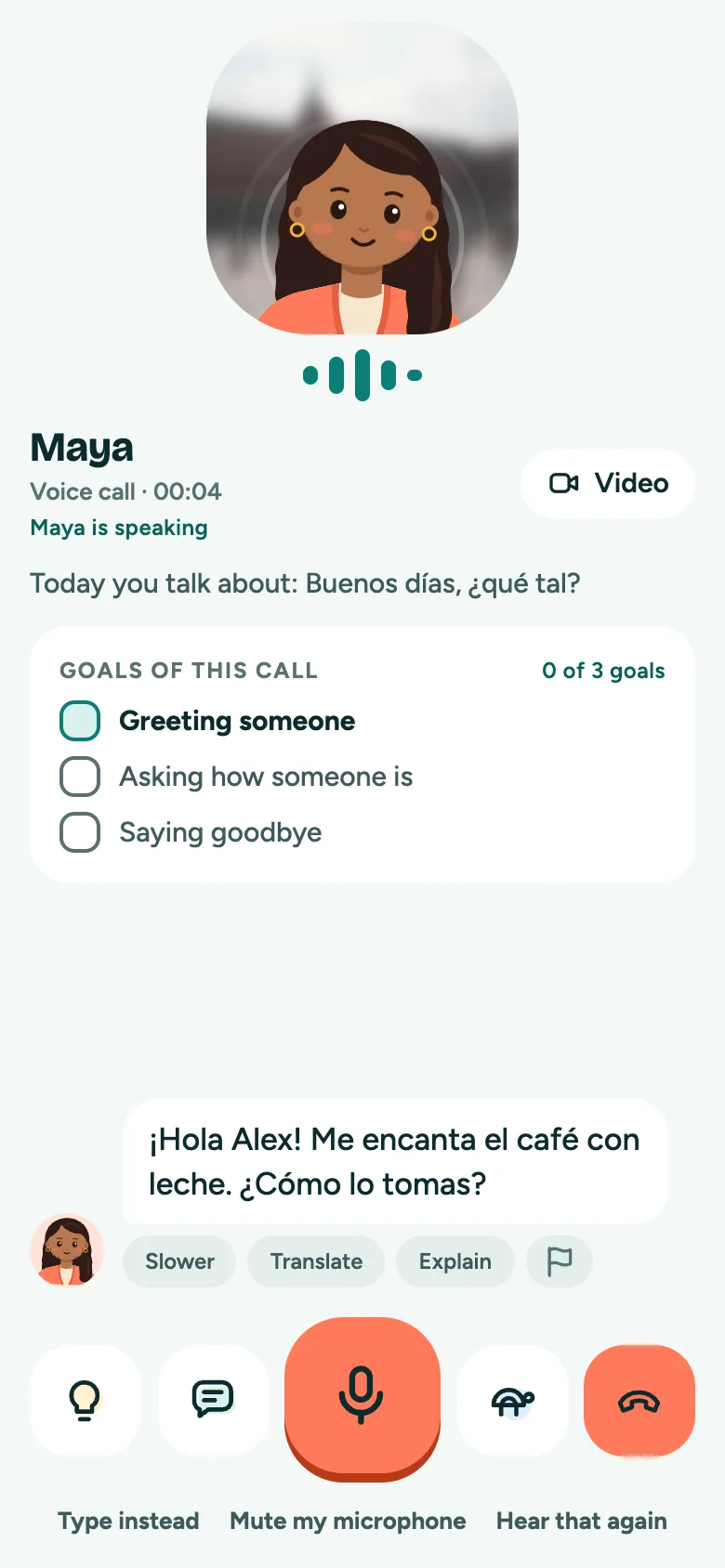
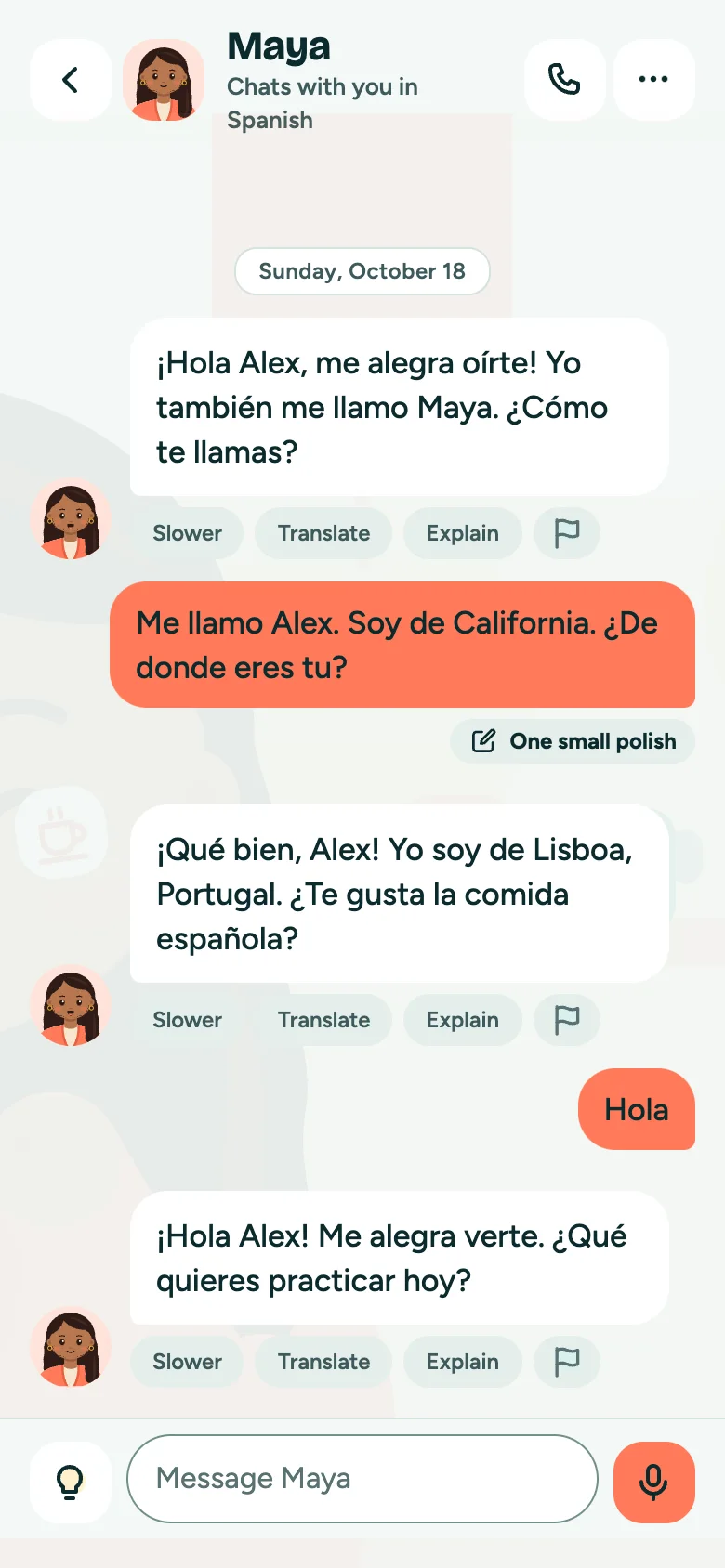
A judgement-free room. You can say the same sentence nine times, badly, and nobody sighs. LingoBestie is built so that you speak in your very first minute: your bestie starts and gives you the words first, and you say them back. If speaking out loud feels too much on a given day, every speaking step also has a tap option.
Quick retries. When you stumble, you try again in two seconds, not next Thursday. You choose how you are polished: at the end, as a nudge, or right away. Your bestie shows you the better way to say it and lets you try again.
It remembers you. Your interview on Thursday, your sister's name, the word you nearly had last week. A bestie keeps this and brings it back at a good moment, and you can open the memories screen and change anything it knows about you.
Five characters to choose from. Nori the sea otter, Maya, Theo, Kiko and Sam each have their own home, job and sense of humour, and you chat, call or video call whichever one suits your mood.
A real course under the chat. About 450 guided sessions per language (460 for English, French, Japanese and Korean) follow the CEFR from Pre A1 to B1, with six courses (English, Spanish, French, German, Japanese and Korean) and lessons explained in whichever of those six languages you think in. The app itself comes in 15 languages. LingoBestie is on iPhone first, and you can start from the App Store.
Where an AI bestie falls short, and how to use it well
Any AI partner has limits, and knowing them makes you a faster learner.
- It can be wrong. A language model sometimes states a rule or a meaning with more confidence than it deserves. When something surprises you, ask the bestie to explain it, then check the nuance with your weekly tutor or a dictionary.
- It tends to be encouraging. Friendly feedback keeps you talking, which is the point, but it can under-report how odd a sentence sounds to a native ear. Ask directly: "Would a native speaker really say this?"
- Register and politeness are the hardest part. Ask for the register you need ("how would I say this to my boss, and to a friend?") and bring the same question to a tutor for a second opinion.
- It cannot read your face. It will not notice that a topic embarrassed you. You steer it, and that is a skill worth practising.
Used this way, the bestie does the volume and the tutor checks the finer points, so each does what it is best at.
Four learner profiles and the blend for each
The beginner
You know almost nothing and want to start without embarrassment. Bestie every day, a tutor from week two or three. Your first month is about hearing sounds and building a bank of phrases, and a tutor's hourly rate is poor value while you can say twelve sentences. Start with 10 to 15 minutes a day with your bestie and the guided sessions, then add one 30 minute tutor trial in week 2 or 3 to catch pronunciation habits early; they are usually easier to change before they settle. A good first sentence to bring to a tutor in Spanish is "Perdone, ¿podría hablar más despacio, por favor?" In German, formal and correct: "Könnten Sie das bitte noch einmal wiederholen?"
The busy professional
You have 20 minutes in a day and a meeting in a month. Short bestie calls, a weekly tutor in your field. Use the bestie to rehearse the vocabulary of your own profession (LingoBestie builds sessions around the moments you will really live, with phrases for your own work), then book one weekly tutor hour to simulate the real meeting. Register matters here. In Japanese, rehearse 「お世話になっております。本日はよろしくお願いいたします。」 with the bestie until it flows, then ask your tutor whether your tone with a senior colleague is right. In French, "Auriez-vous quelques minutes à me consacrer ?" is a polite way to open; a tutor will tell you if your accent makes it sound stiff.
The exam candidate
You have a date. Bestie for daily practice in the exam format, a tutor for mock exams. LingoBestie includes practice in the official formats for the Spanish DELE, the French DELF and DALF, English IELTS and TOEFL iBT, and the Japanese JLPT from N5 to N2, with feedback on every answer. See our guides to DELE preparation, IELTS speaking practice and the JLPT N5 and N4 study guide. Do the volume with the bestie, then pay a tutor for one mock speaking session every two weeks, because the examiner feel is hard to rehearse alone. In the last fortnight, move to weekly.
The traveller
You leave in six weeks and need to function, not to be fluent. Mostly bestie, one or two tutor sessions at the end. Roleplay the airport, the restaurant, the pharmacy and the taxi with your bestie until each scene feels familiar. Practise Korean politeness in context: "조금 천천히 말씀해 주시겠어요?" is polite and useful anywhere. Then book a single tutor hour in the final week for the unpredictable part, someone who answers faster than you expected. If you are picking an app for your destination language, see the guides for Spanish, French, German, Japanese, Korean and English, or the Duolingo comparison.
When a tutor is not worth it
A tutor is not automatically the right spend. Be cautious when:
- You cannot yet say a dozen sentences. You will pay for a lot of silence. Build a base first.
- The tutor talks most of the hour. If you speak for fewer than 20 of 60 minutes, you are paying for a lecture. Ask for more speaking time, or change tutor.
- There is no plan. A good tutor asks about your goal and tells you what the next four lessons will do. A tutor who just "chats" every time is a conversation partner at a teacher's price.
- Corrections are vague. "Good!" for everything helps nobody. You want "this is grammatical but we say it this way, and here is why".
- Cancellation rules are unclear. Check the policy on the platform before you book a package.
Trying two or three tutors before committing to a package is cheap insurance.
A 12 week blended plan
This plan assumes about 20 minutes a day, six days a week, with one rest day (rest days keep your streak, up to two a week). Adjust the numbers; the shape matters more than the minutes. The tutor sessions are 30 to 60 minutes.
| Week | Bestie minutes per day | Guided sessions per week | Tutor sessions | Focus |
|---|---|---|---|---|
| 1 | 10 | 4 | 0 | Sounds, greetings, say it back |
| 2 | 15 | 4 | 1 trial (30 min) | Trial tutor: pronunciation habits |
| 3 | 15 | 5 | 1 (30 min) | Introductions and routines |
| 4 | 20 | 5 | 1 (30 min) | Past events, the first anecdotes |
| 5 | 20 | 5 | 1 (45 min) | Ask questions, handle misunderstanding |
| 6 | 20 | 5 | 1 (45 min) | Review week, redo the hardest sessions |
| 7 | 20 | 5 | 1 (60 min) | Opinions and reasons |
| 8 | 20 | 5 | 1 (60 min) | Role plays from your real life |
| 9 | 20 | 5 | 1 (60 min) | Faster speech, listening to the library |
| 10 | 20 | 5 | 1 (60 min) | Mock conversation, no notes |
| 11 | 20 | 5 | 1 (60 min) | Tutor picks weak spots, bestie drills them |
| 12 | 20 | 4 | 1 (60 min) | Final mock and a plan for the next 12 weeks |
- Bestie hours per week
- Tutor hours per week
| Bestie hours per week | Tutor hours per week | |
|---|---|---|
| 1 | 1.0 | 0.0 |
| 2 | 1.5 | 0.5 |
| 3 | 1.5 | 0.5 |
| 4 | 2.0 | 0.5 |
| 5 | 2.0 | 0.75 |
| 6 | 2.0 | 0.75 |
| 7 | 2.0 | 1.0 |
| 8 | 2.0 | 1.0 |
| 9 | 2.0 | 1.0 |
| 10 | 2.0 | 1.0 |
| 11 | 2.0 | 1.0 |
| 12 | 2.0 | 1.0 |
Total tutor time over twelve weeks is 9 hours, which at a $26 hourly rate is $234. Total bestie time is about 22 hours, covered by a subscription that costs $20 over the same three months on the yearly plan (a quarter of $79.99), or $45 on the monthly plan. The money goes where the human is irreplaceable.
How to get more from tutor sessions
A tutor session costs real money per minute, so do not spend it on warm-ups. Arrive prepared.
- Bring a bestie recap. Open your chat history or the memories screen the day before and copy three sentences you struggled with. Start the lesson with, "These are the sentences I keep getting wrong. Is there a more natural way?"
- Bring words you can recognise but not yet say. The spoken word review in LingoBestie shows you which ones. Ask the tutor to make you use them in a conversation.
- Ask for corrections in your target language, and ask why. "That is wrong" is cheap. "That is grammatical but nobody says it, here is what we say" is what you paid for.
- Take notes, then feed them back. After the lesson, tell your bestie what the tutor corrected and practise it in your next chat or call.
- Use the first five minutes to say what you did this week. It is a low-stakes warm-up in the target language and it shows the tutor your level.
Where each option fits in your week
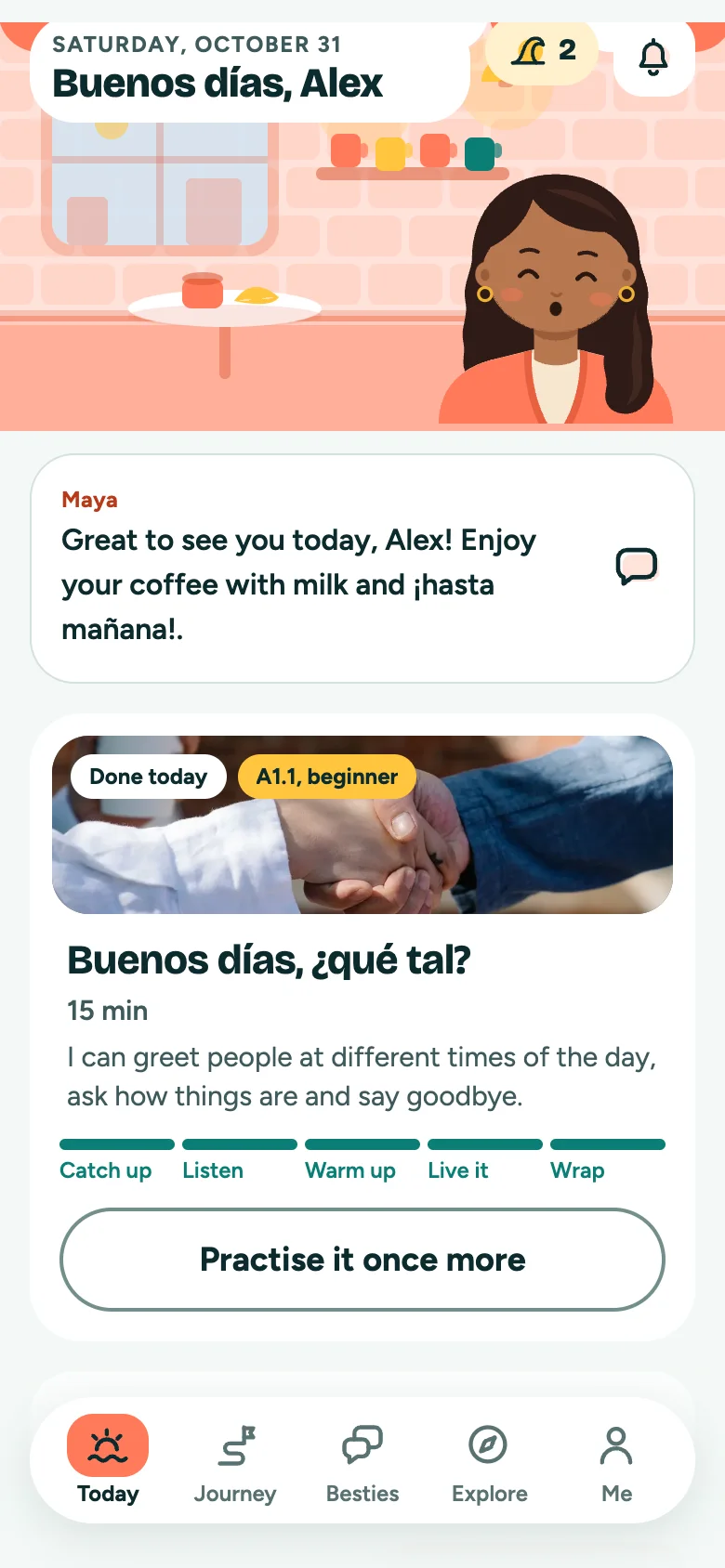
The Today screen in LingoBestie is the quiet engine of the plan. It shows your plan for the day, and your tutor session sits on top of it once a week. When the lesson with a person is no longer the only time you speak, you can afford to make that lesson more ambitious.
A tutor is the best use of a rare, expensive hour. A bestie is the best use of the many other hours in your week. If you want a wider view of the field, read our guides to AI language tutor apps and the best language learning apps, and for habits that carry over to any method, how to practice speaking a new language and how long it takes to learn a language.
LingoBestie is on iPhone first. You can download it from the App Store and start with a 7 day free trial on the yearly plan.
FAQ
Is an AI tutor as good as a human tutor?
For daily speaking volume, patience and instant retries, an AI bestie is hard to beat. For cultural nuance, live unpredictability and exam preparation with a person's judgement, a human tutor is better. We know of no controlled study that settles it, which is why we suggest using both.
Can AI replace a language teacher?
Not completely, and it does not need to. An AI bestie can replace much of the daily practice a teacher cannot be there for. A teacher is still the best check on nuance, register and exam technique, and a good one tells you what to do next. Many learners do best with a weekly teacher and daily AI practice.
Is AI safe to learn pronunciation from?
It is good for daily repetition and for hearing models of native speech, and the besties are built to sound native in the languages they speak. For fine points of accent and tone, a native tutor's ear is the better judge, so book one trial lesson in the first weeks for a pronunciation check, then keep practising daily.
How many hours a week should I speak?
There is no official number. As a guide, our 12 week plan has you speaking about 1.5 to 2 hours of bestie time and up to an hour with a tutor each week, which is roughly 1.5 hours of your own speaking at our estimated shares. Short, frequent practice beats one long session, so pick a daily amount you can keep.
How much does a language tutor cost?
It depends on the tutor, because marketplace teachers set their own prices. Preply's English page lists averages of $23 to $26 per hour and its Spanish page $26 to $29 per hour, with lessons starting from $3. italki's guide says community tutors typically charge $4 to $20 per lesson and professional teachers $10 to $40. Prices checked October 2026; see Sources for the links.
Are language tutors worth it?
Yes, for specific things: pronunciation in the first weeks, cultural nuance, exam practice and a regular appointment that keeps you accountable. They are less efficient as your only source of speaking practice, because much of a tutor's hour is the tutor talking.
Can I use both on a tight budget?
Yes. Take the yearly Plus plan ($79.99, about $6.67 a month) for daily practice, and book a tutor every second or third week instead of weekly, or choose a lower-priced community tutor. A $5 to $10 lesson every other week used for the sentences you prepared with your bestie is a very efficient way to spend a small budget.
Preply vs AI: which is better?
They do different jobs. Preply gives you a person at an hourly price you choose. An AI bestie gives you daily practice at a flat subscription. The combination is stronger than either alone.
italki vs an app: should I switch?
You do not have to. If you already like your italki teacher, keep the weekly lesson and add a bestie for the days in between. If you have no teacher yet, start with the bestie and add a tutor from week 2 or 3.
Lingoda vs an app: is a class platform enough?
Lingoda offers structured live classes and its plans renew every four weeks. You get scheduled speaking with a teacher and classmates, though your own share of the talking is smaller in a group of three to five. An app adds the daily reps between classes.
Should I choose a tutor or an app to learn a language?
Choose both if you can. If you have to choose one, start with the app and add a tutor once you can hold a short conversation, so the tutor's hourly rate goes toward polish and not toward basics.
Is LingoBestie free?
Learning in LingoBestie needs Plus, and the yearly plan starts with a 7 day free trial with no payment today. You get a reminder before any charge. LingoBestie is on iPhone first.
Sources
All checked October 2026.
- Preply, "Online English tutors": average hourly rates $26 (native) and $23 (non-native). https://preply.com/en/online/english-tutors (checked October 2026)
- Preply, "Online Spanish tutors": $26 (native) and $29 (non-native) hourly averages, FAQ "starts from $3". https://preply.com/en/online/spanish-tutors (checked October 2026)
- Lingoda, pricing page: two euro price ladders for 60 minute classes (EUR 36.99/24.49/20.99/18.99 and EUR 15.99/10.49/8.99/8.49 for 5/12/20/40 classes), the group tab described as 3 to 5 students, renewal every four weeks, 7 day free trial. The ladders are not labelled on the page. https://www.lingoda.com/en/pricing/ (checked October 2026)
- italki, "italki price" guide: community tutors typically $4 to $20 per lesson, professional teachers $10 to $40. https://www.italki.com/en/blog/italki-price (checked October 2026)
- Bibauw, S., Van den Noortgate, W., François, T. and Desmet, P., "Dialogue systems for language learning: A meta-analysis", Language Learning & Technology, 2022. https://www.lltjournal.org/item-detail/1035 (checked October 2026)
- LingoBestie, App Store listing and in-app plans: 6 courses, 15 interface languages, 7 day free trial on the yearly plan, $14.99 monthly and $79.99 yearly in the US storefront, Plus daily allowance up to 2 hours (checked October 2026; the store shows your local price). https://lingobestie.com
A note on method. Speaking share is our estimate, not a measured figure, and the sensitivity table shows how the answer changes if you change it. Prices can change; check the linked pages before you buy.